The Inheritance
What the Glazer family received in 2005, what was done with it, and what it will now cost to recover.
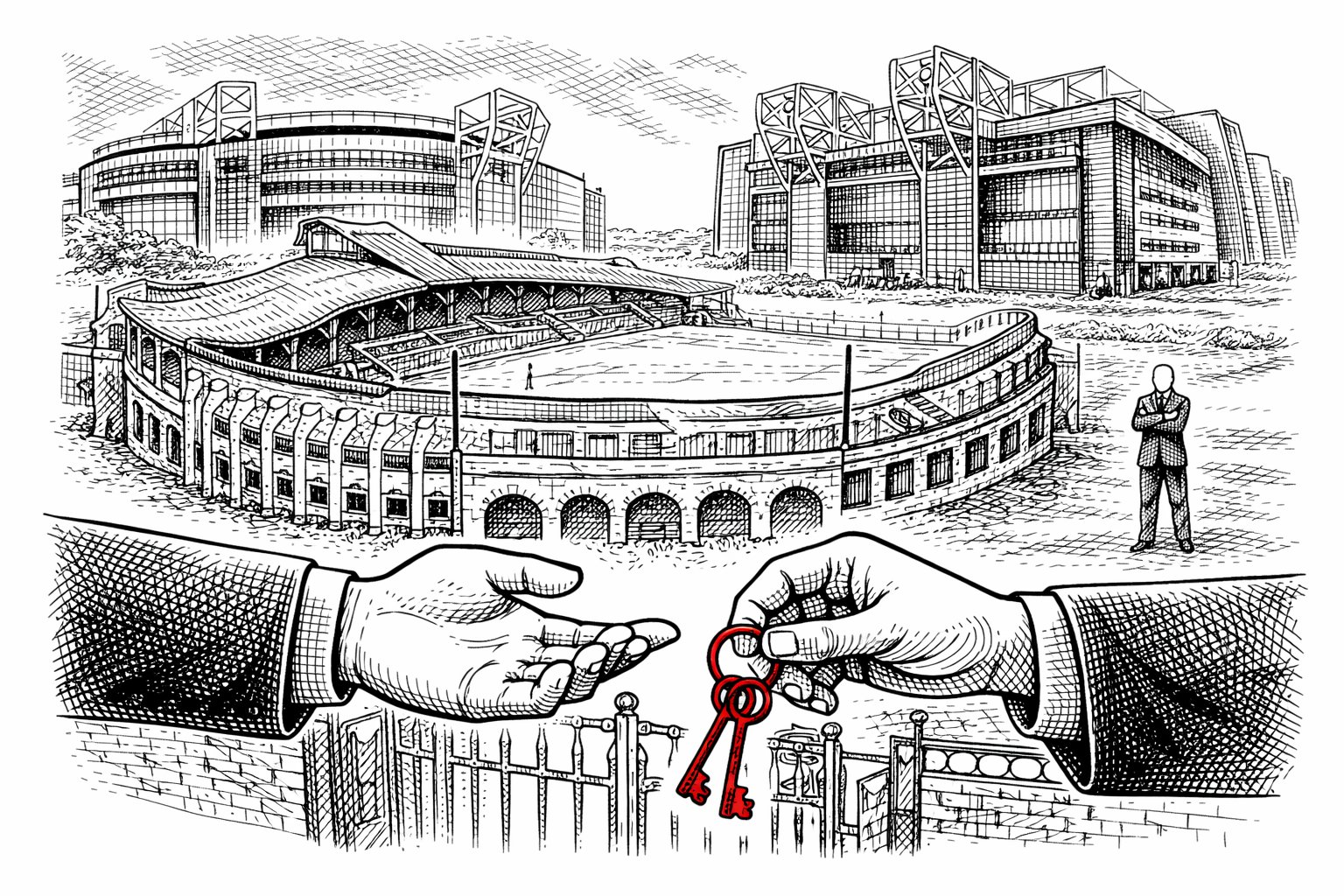
There is a detail in the story of Old Trafford's decline that does not receive the attention it deserves.
The last time Manchester United carried out significant structural work on their stadium, the work had already been approved. The north-west and north-east quadrant second tiers - the final expansion of Old Trafford, completed between July 2005 and May 2006, which added approximately 8,000 seats - were authorised before the Glazer family completed their takeover in June 2005.1 The new owners inherited a ground mid-improvement. They saw the work through to completion, reached a peak capacity of 76,212 by 2007,2 and have not initiated a single structural expansion since.
Nineteen years have passed. Old Trafford is, on paper, the same stadium it was in 2006. It is not the same stadium in any other sense.3
What Was Received
In May 2005, when Malcolm Glazer completed the leveraged buyout that would eventually load approximately £558.9m of acquisition debt onto Manchester United's balance sheet,4 he inherited an asset of considerable financial power.
Old Trafford in 2005 was the largest club football stadium in England. Its matchday revenue was, by Deloitte's accounting, the highest generated by any football club in the world. The "Theatre of Dreams" - Bobby Charlton's phrase, earned through Munich, through the European Cup of 1968, through the treble of 1999 - was not merely a sentimental description.5 It was a financial descriptor. The ground produced more income from the turnstile, the hospitality suite, and the corporate box than any other stadium in the game.
The club that sat inside it had won nine of the previous twelve Premier League titles. The manager who ran it had agreed to remain. The commercial machine was generating revenues that placed Manchester United at or near the top of the Deloitte Football Money League in ten of its first fifteen editions.6
The Glazers did not build this. They bought it. That distinction matters for everything that follows.
The Nineteen Years
What separates the world of elite football infrastructure in 2005 from the world of elite football infrastructure in 2025 is a generation of committed capital expenditure by clubs who understood that a stadium is not a fixed asset. It is an appreciating one, if you invest in it. It depreciates if you do not.
In 2006, Arsenal opened the Emirates Stadium. The move from Highbury - a 38,000-capacity ground they had maximised - to a 60,000-seat modern arena transformed the club's financial position.7 By 2023/24, Arsenal's matchday revenue had reached £131m for the season, making them the second-highest earners in the Premier League from this source.8
In 2019, Tottenham Hotspur opened their new stadium on the footprint of White Hart Lane. The old ground held 36,284. The new one holds 62,850. The project cost approximately £1bn, financed through bonds, bank loans, and £32m in public regeneration grants.9 Spurs' matchday revenue in 2022/23 was £117.6m - almost as much as Manchester United generates from a stadium with eleven thousand more seats.10 The new ground earns approximately £4.5m per match11 and generates income from NFL games, boxing, concerts, and non-matchday hospitality in ways White Hart Lane never could.
Liverpool expanded Anfield. The Main Stand redevelopment completed in 2016, the Anfield Road Stand in 2023, raised total capacity above 61,000.12 In 2024/25, Liverpool became the highest-earning Premier League club by total revenue - the first time in the Deloitte Money League's history that Manchester United had been overtaken by their great domestic rival.13
Real Madrid renovated the Bernabéu. The project, costing approximately £887m, converted the stadium into a year-round entertainment venue.14 Their matchday revenue in 2023/24 increased 103% in a single year as Personal Seat Licences and new VIP infrastructure came online. They became the first football club to generate €1bn in annual revenue.15
"If you went back 10 or 15 years, and you looked at Manchester United's matchday revenue, it was the industry leader. If you looked at their ability to generate commercial revenue, it was the benchmark by which everybody then went to market and set their strategy. I don't think that remains the case."
Tim Bridge, Sports Business Group Leader, Deloitte - January 2026During this same period, Manchester United undertook no major structural work at Old Trafford.
The roof leaked in 2012. In 2019. In 2023. Most visibly, in May 2024, when a thunderstorm during a home defeat to Arsenal sent water cascading through the stands and footage circulated worldwide.16 These were not isolated incidents. They were recurring evidence of a building managed for use rather than maintained for purpose. In 2023, when UEFA compiled its host venue list for Euro 2028 - a competition held partly in England - Old Trafford was not included. The club was unable to confirm the stadium would be available for the competition.17
The ground that in 2006 was the benchmark for global football infrastructure had, by 2023, fallen below the standard required to host a European Championship match.
The Compounding Cost
To understand what the decision not to invest has cost, it helps to track what the decision not to invest enabled.
Manchester United's matchday revenue has not grown meaningfully since 2013. One analysis found that revenue per fan at Old Trafford had moved from approximately £1,445 to £1,488 over a decade - a change of less than 3% in nominal terms, negative in real terms.18 Tottenham, by contrast, effectively doubled their revenue per spectator when they moved to their new stadium and refashioned the matchday experience around extended hospitality, in-stadium bars, and non-football events.
| Club | Stadium | Capacity | Matchday Rev. | Per Match |
|---|---|---|---|---|
| Manchester United | Old Trafford (2006) | 74,000 | ~£136m | ~£4.0m |
| Arsenal | Emirates (2006) | 60,700 | £131m | ~£5.1m |
| Tottenham Hotspur | New stadium (2019) | 62,850 | £117.6m | ~£4.5m |
| Liverpool | Anfield (expanded 2023) | 61,000 | ~£112m | ~£4.2m |
Sources: Deloitte Football Money League; Matchday Finance; Swiss Ramble. Figures approx. 2022/23 or latest available season.
Old Trafford holds 11,000 more spectators than the Tottenham Hotspur Stadium. It earns less per match and less per seat. The largest club stadium in England has been, for a decade, one of its least efficiently monetised.
The capital that was not spent on the stadium was consumed elsewhere. Between 2005 and 2023, Manchester United paid approximately £906m in interest charges on the debt loaded onto the club at the time of the Glazer takeover.19 The club paid approximately £154m in dividends to shareholders between 2015 and 2022.20 In the same period, the infrastructure that generated the revenue that underwrote those extractions was allowed to age without investment.
Approximate sum of debt interest charges (~£906m) and shareholder dividends (~£154m) across the Glazer ownership period to 2022. Sources: Kieran Maguire / Sky Sports; Dividends entry.
This is the inheritance argument made concrete. The Glazers received a stadium that was the most productive matchday venue in world football. They managed it as a cash flow rather than as a capital asset. The compound effect of nineteen years of non-investment is not simply a leaking roof or cramped concourses. It is the gradual erosion of a structural competitive advantage - one that rivals have, in several cases, now surpassed.
The Proposal
In March 2025, Manchester United announced plans to build a new 100,000-seat stadium on land adjacent to the existing Old Trafford. The project, designed by Foster + Partners and referred to in architectural documentation as "New Trafford Stadium", would make it the largest football stadium in the United Kingdom and the second-largest in Europe after Camp Nou. Jim Ratcliffe described the ambition as creating "the Wembley of the North."21
The announcement was made a day after Ratcliffe had said the club would have run out of money by the end of 2025 without the cost-cutting measures implemented since his arrival.22
The estimated cost is £2bn. The club has confirmed it will fund the stadium itself; no public money will be used for the build. Andy Burnham, Mayor of Greater Manchester, was unequivocal: "There will be no public money for this stadium. Manchester United will be solely responsible for the building of their new home."23
One year after the announcement, no funding has been secured for the project.24
Manchester United's total football net debt, as of December 2025, stands at £1.047bn - a new high, and £49m more than when Ratcliffe acquired his stake.25 The proposed canopy roof design - an architectural signature of the Foster + Partners scheme - is estimated by industry sources to add up to £200m to construction costs.26 A land dispute has emerged as a structural obstacle: the Freightliner terminal adjacent to Old Trafford occupies land the club requires. The club's own estimate of that land's value is approximately £40-50m. The landowner's valuation is reported at approximately £400m.27
Lord Coe, who chairs the Old Trafford Regeneration Task Force, travelled to New York in July 2025 seeking potential investors.28 A Mayoral Development Corporation has been established with the power to force compulsory land purchases, though the Mayor has downplayed its immediate use.
The club's original target of opening the new ground by the 2030/31 season is no longer considered achievable by observers. Construction has not begun.
The Structural Question
There is a version of this story in which the new stadium proposal represents the correction of nineteen years of deferred investment - a reckoning, however expensive, with the consequences of what was not done. In that version the bill is arriving, the ownership is paying it, and the asset will be restored to the level of ambition the club's history and global standing demand.
There is another version, which the financial evidence invites more cautiously.
Tottenham's £1bn stadium, financed through bonds and loans, produced annual interest payments of approximately £30m and depreciation charges of approximately £70m. These factors contributed to cumulative losses of over £160m across three seasons - losses largely excluded from PSR calculations because infrastructure depreciation is an allowable deduction, but representing real capital costs nonetheless.29 The stadium is, by most measures, a correct long-term investment. It is not costless. It constrained Tottenham's squad investment during the build period in ways that were evident on the pitch.
Manchester United's proposal is for a stadium twice as expensive, in a context of £1bn existing debt, six consecutive years of net losses totalling approximately £552m,30 and a squad cost ratio estimated at approximately 86% of revenue - above the threshold UEFA's Financial Sustainability Regulations define as compliant for 2024/25.31 The CEO has acknowledged the risk to squad investment explicitly.32 The funding remains unresolved.
The club's own internal communications, as reported in early 2025, stated that it was "in danger of failing to comply with PSR/FFP requirements in future years" if cost reductions were not implemented.33 Building a £2bn stadium while managing that constraint requires either a significant equity injection - something the Glazer family did not provide across nineteen years of ownership - or external investment through naming rights, bonds, or stadium entity stakes that has not yet been announced.
What the fanbase has glimpsed, through internal consultations that leaked in 2025, is a proposed commercial model for the new ground: hospitality accounting for up to 40% of capacity; 15-year season ticket commitments with large upfront payments; premium ticketing structures bundling away match access and concert tickets.34 A survey of 30,000 supporters found opinion split nearly evenly - 52% in favour of a new ground, 48% preferring renovation of the existing one.35
The Inheritance, Completed
Bobby Charlton called it the Theatre of Dreams. That name was not invented by a marketing department. It was earned through Munich, through the European Cup of 1968, through the treble of 1999. The ground held those memories, and the memories made the ground something more than a venue.36
"Our current stadium has served us brilliantly for the past 115 years, but it has fallen behind the best arenas in world sport."
Sir Jim Ratcliffe, Manchester United co-owner - March 2025When the Glazers acquired Old Trafford in 2005, they received not just a stadium but a cultural institution with global resonance and world-leading financial productivity. They managed it without investing in it for nineteen years. They extracted dividends from it. They serviced the debt they had loaded onto it. They watched rivals build and chose not to match them.
The consequence is a £2bn bill, a disputed piece of land, an unresolved funding structure, and a ground that was excluded from Euro 2028 because its future could not be guaranteed.
The new stadium - if it is built, when it is built - will not be built by the ownership that made it necessary. Ratcliffe and INEOS now own the sporting decisions. The Glazers retain majority ownership of the equity. The investment case for the new ground rests on revenue projections that assume Champions League football and a level of on-pitch performance that has not been achieved for twelve years.
An inheritance can be grown or it can be diminished. Old Trafford is the clearest single illustration in the Glazernomics archive of what diminishment looks like over two decades - not through a single dramatic decision, but through the accumulated weight of nineteen years of choosing not to act.
The bill has arrived. The amount is £2bn, minimum.