Overview
Capital expenditure (capex) at Manchester United refers to investments in property, plant and equipment - principally the Old Trafford stadium and Carrington training complex - as distinct from spending on player registrations, which is accounted for separately as an intangible asset.1 Infrastructure capex does not count toward Profit and Sustainability Rule (PSR) calculations, making it financially distinct from player acquisition costs.2
Annual PPE capex remained at historically low levels through the Glazer era, running at approximately £13–17 million per year from 2019 to 2024, before jumping to £44.7 million in FY2025 following INEOS-funded Carrington investment.3
Old Trafford
Manchester United expanded Old Trafford from approximately 68,000 to 74,240 seats in work completed prior to the 2006/07 season - the last major capacity increase at the stadium.4 Reported Old Trafford capex in the three fiscal years ending June 2025 was £13.4 million (FY2023), £8.2 million (FY2024), and £13.1 million (FY2025).5 The club confirmed in May 2024 that it would not undertake roof repairs until a decision was reached on comprehensive stadium redevelopment.6
The Old Trafford Regeneration Task Force, formed in March 2024, concluded in January 2025 that renovation to 87,000 capacity would cost an estimated £800 million to £1 billion, while new construction at 100,000 capacity would cost approximately £2 billion.7
Carrington
The Carrington training complex opened in 2000 at an initial cost exceeding £60 million. The last expansion prior to INEOS involvement was a £25 million medical and sports science building in 2012/13.8 No further major investment occurred until INEOS assumed football operations control in February 2024, funding a £50 million men's first team facility redevelopment completed in August 2025 and a £10 million women's and academy building in 2024.9
Net capital expenditure on property, plant and equipment was £44.7 million in FY2025, an increase of £27.2 million year-on-year, attributed primarily to the Carrington redevelopment.3 Capital expenditure was £17.0 million in Q1 FY2026, an increase of £6.7 million from the prior year quarter due to finalisation of the Carrington project.10
Infrastructure vs Player Registration Capex
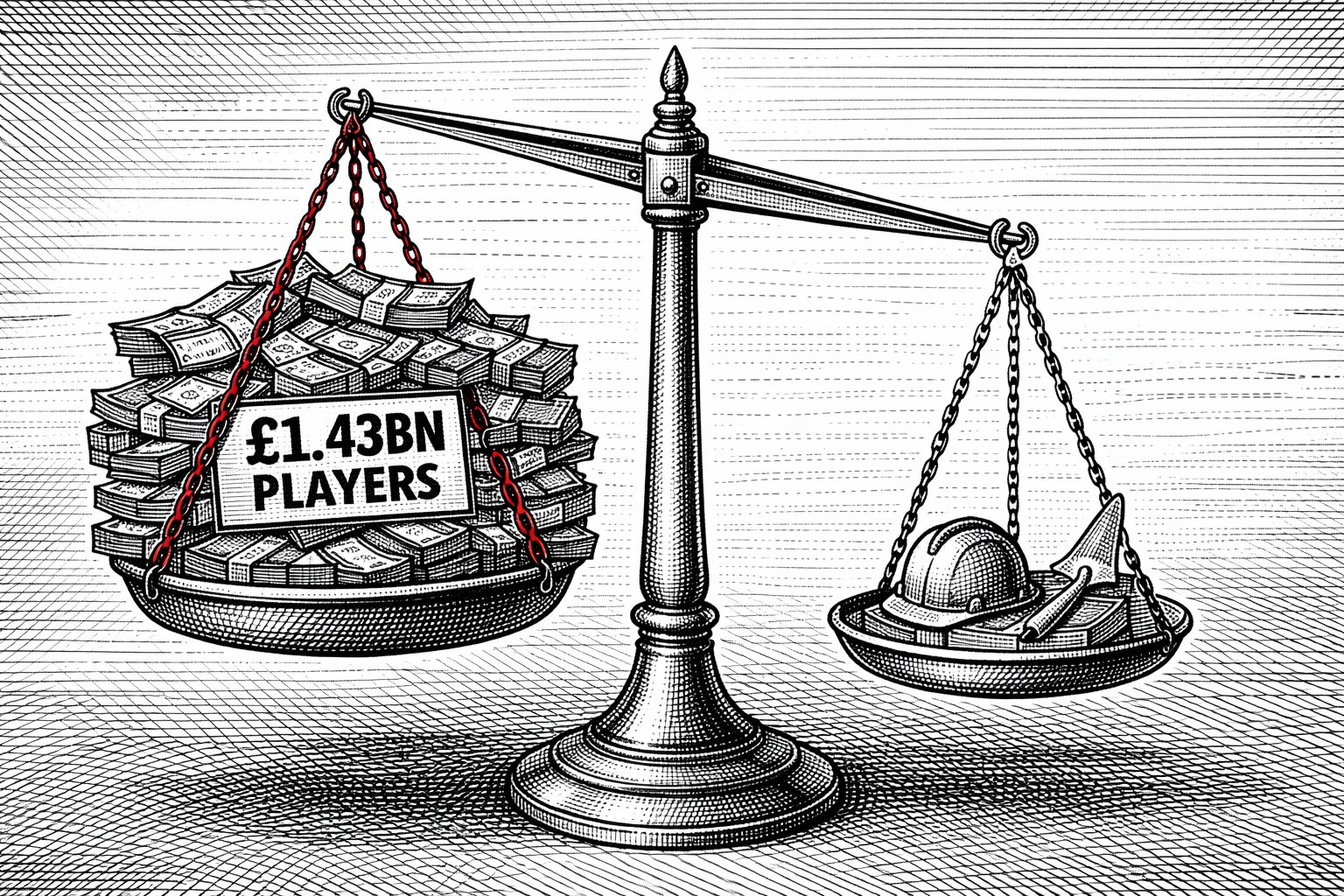
The contrast between infrastructure capex and player registration cash outflows illustrates the capital allocation priorities of the Glazer era. In FY2025, the club spent £44.7 million on property, plant and equipment - and £278.8 million on player registrations, a club record.11 Over the decade FY2015 to FY2024, gross player registration spending totalled approximately £1.6 billion; infrastructure capex over the same period was approximately £150 million.12
Swiss Ramble analysis found that over approximately the decade to 2022, Manchester United spent £136 million on infrastructure capital expenditure - less than both Fulham and Leicester City in that period, and dwarfed by Tottenham Hotspur's £1.4 billion (principally the construction of their new stadium).13
Peer Comparison
Manchester United's infrastructure investment record over the decade to 2022 (approximately £136 million) compared unfavourably to several Premier League peers. Tottenham Hotspur invested approximately £1.4 billion over the same period, largely through the construction of their 62,850-seat stadium opened in 2019. The Deloitte Football Money League 2025 noted that Liverpool had generated higher attendances and non-matchday revenue following infrastructure investment, and that Manchester United was "currently exploring available options to redevelop Old Trafford."14
Accounting Treatment
Infrastructure capital expenditures are added to the property, plant and equipment balance on the club's balance sheet and depreciated using the straight-line method over their useful lives.1 Unlike player amortisation, depreciation of physical assets is not excluded from Adjusted EBITDA under the club's definition - it is stripped out in that metric under "depreciation and impairment."15 Infrastructure capex is PSR-exempt: spending on facilities, academies, and women's teams does not count against a club's three-year permitted loss threshold.
Summary
Capital expenditure on infrastructure at Manchester United ran at maintenance-level investment (£13–17 million annually) through most of the Glazer era before rising to £44.7 million in FY2025 due to INEOS-funded Carrington investment. The structural contrast with player registration spending - £278.8 million in FY2025 alone - and the comparison with peer clubs illustrates the relative priority given to physical asset development versus squad acquisition throughout the ownership period.
References
- 1.Manchester United Form 20-F (various). Accounting policy - property, plant and equipment at cost less depreciation. ir.manutd.com
- 2.Premier League PSR Regulations. Infrastructure capex exempt from three-year loss calculation. premierleague.com
- 3.Manchester United Form 20-F FY2025. Net PPE capex £44.7M; increase of £27.2M attributed to Carrington. ir.manutd.com
- 4.Manchester United (2006). Old Trafford capacity increase to 74,240 completed pre-2006/07 season. manutd.com
- 5.Manchester United Form 20-F (FY2023, FY2024, FY2025). Old Trafford capex: £13.4M, £8.2M, £13.1M. ir.manutd.com
- 6.Manchester United (May 2024). Roof repairs deferred pending stadium redevelopment decision. manutd.com
- 7.Old Trafford Regeneration Task Force (January 2025). Renovation: £800M–£1Bn; new build: ~£2Bn. manutd.com
- 8.Manchester United (2013). Carrington medical and sports science building: £25M. manutd.com
- 9.Manchester United / INEOS (2024). Carrington: £50M men's facility (Foster + Partners, completed Aug 2025); £10M women's and academy building. manutd.com
- 10.Manchester United Q1 FY2026 filing. PPE capex £17.0M; +£6.7M year-on-year for Carrington finalisation. ir.manutd.com
- 11.Manchester United Form 20-F FY2025. Player registration cash outflows £278.8M - club record. ir.manutd.com
- 12.Swiss Ramble / Manchester United Form 20-F. Player capex ~£1.6Bn vs infrastructure ~£150M, FY2015–FY2024. @SwissRamble
- 13.Swiss Ramble (2022). United £136M infrastructure; less than Fulham and Leicester; vs Tottenham £1.4Bn. @SwissRamble
- 14.Deloitte Football Money League 2025. Liverpool matchday uplift from infrastructure; United "exploring options." deloitte.com
- 15.Manchester United Form 20-F (various). Adjusted EBITDA definition excludes depreciation and amortisation. ir.manutd.com