Overview
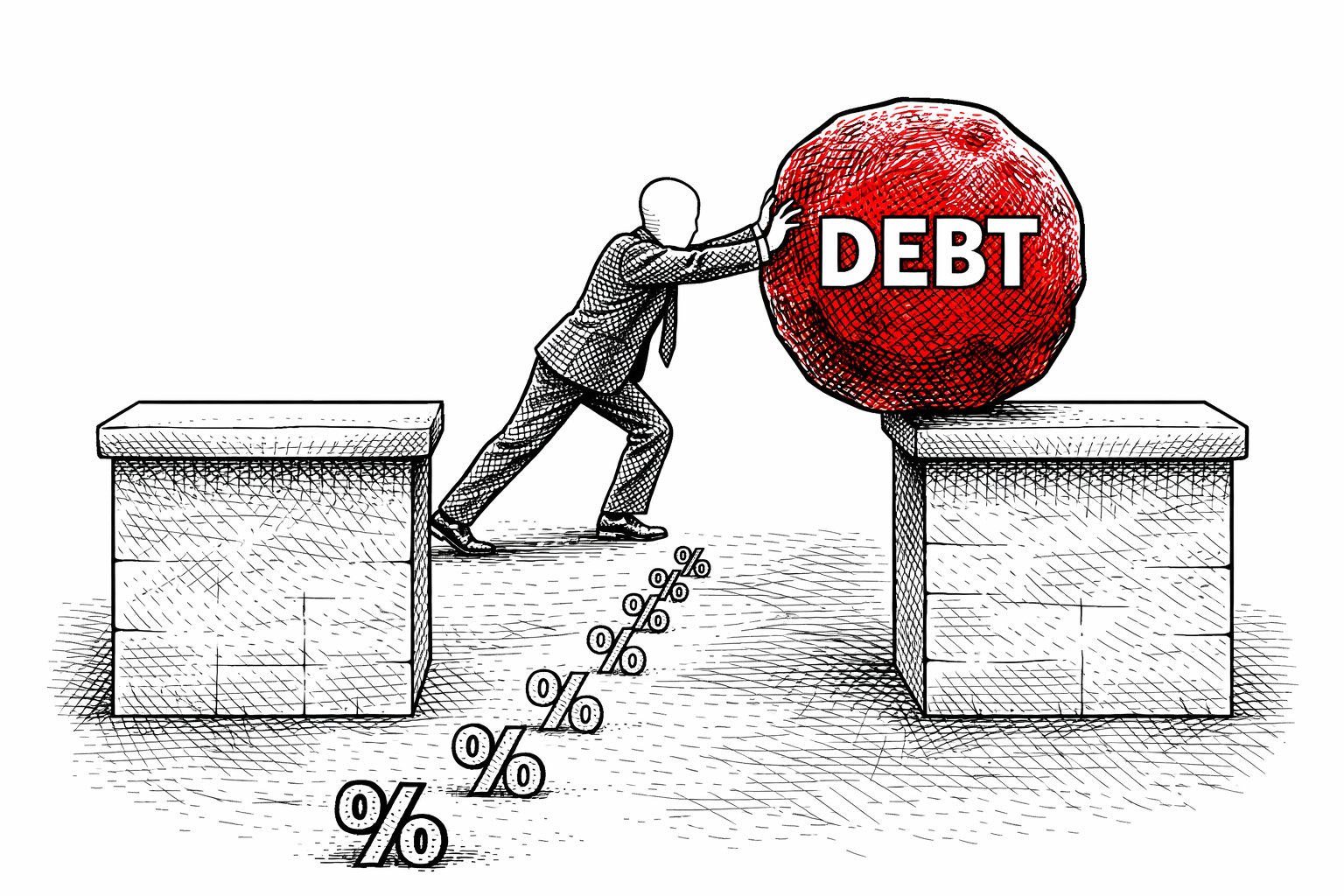
When the Glazer family completed their leveraged buyout of Manchester United in May 2005, approximately £540m of acquisition debt was placed across two structures: approximately £265m of senior bank debt secured directly against the club's assets, and approximately £275m of payment-in-kind (PIK) loans held at the holding company level at an initial interest rate of 14.25% per annum.1,2 Neither element has been retired in any meaningful sense. Over the following twenty years, the debt has been restructured five times, each event reducing the headline interest rate, extending the maturity profile, or replacing one instrument with another of different characteristics – but not reducing the principal outstanding to zero.
This entry documents each major refinancing event from the original 2010 bond issue through to the anticipated 2027 refinancing of the $425m senior secured notes currently outstanding. The entry does not overlap with the Debt Structure entry, which covers the aggregate debt trajectory; it focuses specifically on the mechanics, terms, and strategic context of each restructuring event.
| Date | Event | Instrument / Rate | Amount | Annual interest change |
|---|---|---|---|---|
| May 2005 | LBO – original debt | Bank debt + PIK (14.25%→16.25%) | ~£540m | ~£62m/yr baseline1 |
| Jan 2010 | Bond issue | 8.75% (GBP) + 8.375% (USD); due 2017 | £504m raised | £62m → £45m/yr5,6 |
| Nov 2010 | PIK loans repaid | 16.25% PIK cleared | ~£220m | PIK interest eliminated8 |
| May 2013 | Term loan (BofA) | LIBOR + 2.75% (~2.78%) | £200m equiv. | ~£10m/yr saving12,13 |
| Jun 2015 | $840m refinancing | 3.79% notes (due 2027) + amended term loan | $840m total | £35m → £20m/yr14,15 |
| 2025 | Term loan extended | SOFR + 1.25–1.75%; due Aug 2029 | $225m | Floating rate18 |
| Jun 2027 | Notes maturity (upcoming) | 3.79% notes mature; new rate unknown | $425m | Rate to increase21,22 |
Event I: The 2010 Bond Issue
By January 2010, total debt across both club and holding company structures had grown to £716.5m – up from approximately £540m at the 2005 LBO, driven by the compounding of PIK interest.3 The immediate catalyst for refinancing was the approaching maturity of the senior bank debt and the increasingly urgent need to address the PIK loans, which were compounding at 14.25% per annum and would require full repayment by 2017 if not addressed.
On 29 January 2010, via subsidiary MU Finance plc, Manchester United issued £504m in senior secured notes in two tranches: £250m at 8.75% (GBP-denominated) and $425m at 8.375% (USD-denominated), both due to mature on 1 February 2017.5 The proceeds were used to repay the £509m of outstanding senior bank debt in full.6 Annual interest fell from approximately £62m to approximately £45m per annum.
The strategic purpose of using bonds rather than replacement bank debt was the covenant structure. The bond prospectus contained covenants that explicitly permitted the Glazers to route club revenues to their holding company to repay the PIK loans – a restriction the existing bank debt had prevented.7 The bond also entitled the Glazers to dividend payments of up to £20m annually, another facility the bank debt covenants had not allowed. The 2010 bond was therefore not simply a cheaper refinancing; it was an instrument designed to unlock the Glazer family's ability to use club cash flows for purposes beyond debt service.
Event II: The November 2010 PIK Repayment
In November 2010, the Glazer family repaid the outstanding PIK loans in full – approximately £220–244m at the 16.25% compounding rate that had been in force since August 2010.8,2 The club stated that none of its own money had been used for the repayment. The source of the funds was never publicly confirmed; suggested mechanisms included the sale of a minority stake in the club, the sale of other Glazer family assets, or the re-leveraging of the PIK position with a replacement loan at a lower rate.8
The repayment was financially necessary. Had the PIK loans remained outstanding until their 2017 maturity, they would have grown to over £600m due to the compounding of interest at 16.25%.9 The combined effect of the January bond issue and the November PIK repayment was to restructure the entire Glazer-era debt into a single, lower-cost, longer-maturity instrument – at the cost of a higher interest rate than the original bank debt, but a lower effective rate than the PIK-inclusive position.
Event III: The May 2013 Term Loan
In May 2013 – the month Manchester United won their 20th league title under Ferguson's final season – the club refinanced £177.78m of the sterling 8.75% bonds and $22.09m of the USD bonds with a new term loan arranged by Bank of America, at an estimated starting interest rate of approximately 2.78% (LIBOR plus 2.75%).12 The transaction produced an annual interest saving of approximately £10m per year and reduced total gross debt to approximately £307m.13
Executive Vice-Chairman Ed Woodward described the refinancing in the FY2013 earnings release, stating that the club had delivered on its objectives and that the commercial business continued to be "a very powerful engine of growth."13 The 2013 refinancing was the first to materially reduce the gross debt outstanding since the 2012 IPO had retired $101.7m of the USD bonds.10
Event IV: The June 2015 Refinancing ($840m)
The most structurally significant refinancing event in the Glazer era took place in June 2015, when Manchester United completed a $840m package comprising three elements: new $425m senior secured notes at a fixed rate of 3.79%, maturing 25 June 2027; an amended and restated term loan of $225m at LIBOR plus 1.25–1.75%, initially maturing June 2025; and a new £125m revolving credit facility.14
The primary use of proceeds was the redemption of $269m of the remaining 8.375% USD notes due 2017 – effectively replacing the remaining 2010 bond obligation with a new, lower-rate instrument and extending the maturity by ten years.16 The transaction reduced annual interest costs from approximately £35m to approximately £20m, saving roughly $10m per year.15
Swiss Ramble noted in its FY2016 analysis that even at the post-2015 low-rate level, Manchester United's annual interest payments of £20m exceeded those of every other Premier League club – Arsenal, the next highest, paid £13m.25 The 2015 refinancing locked in the best interest rate available to the club throughout the entire Glazer ownership period.
Post-2015: Term Loan Extension and the INEOS Period
In FY2017, the club repaid the $233.3m term loan in full, bringing net debt to £210.9m – the lowest level since the 2005 takeover.17 From this point, debt began to increase again, driven initially by COVID-19 pandemic impacts on liquidity in FY2020–21 and subsequently by transfer spending under INEOS from FY2024 onwards.
The $225m term loan, originally maturing June 2025, was extended to August 2029.18 As at December 2025, per the club's SEC Form 6-K, the two long-term debt instruments outstanding were: $425m senior secured notes at 3.79%, maturing 25 June 2027 (£315.1m sterling equivalent, net of issue costs); and the $225m secured term loan at SOFR plus 1.25–1.75%, maturing August 2029 (£166.2m sterling equivalent).19 All assets – including Old Trafford and player registration contracts – are pledged as security against both instruments.27
The revolving credit facility, with a cap of £350m, was drawn at £295.7m as at Q2 FY2026, approaching its ceiling – primarily reflecting working capital requirements and transfer fee instalments.28 Club football net debt reached a record £1.047bn in December 2025, approximately £49m higher than at the time of Ratcliffe's investment.20
Event V: The Upcoming 2027 Refinancing
The $425m senior secured notes at 3.79% mature on 25 June 2027. As at April 2026, the club had not publicly announced a refinancing arrangement. Sources familiar with the club's finances, reported by The Athletic, expected a refinancing to be concluded between spring and summer 2026.21
The 2015 rate of 3.79% was achieved in a low global interest rate environment that no longer exists. A two percentage point increase – a conservative assumption given current market conditions – would add over £6m annually to the club's interest burden on this tranche alone.22 Annual net interest payments have already exceeded £30m for three consecutive years, driven by increased drawing on the floating-rate revolving facility and a higher base rate environment.23
The 2027 refinancing event will be the first in the Glazer era to potentially increase the club's financing costs rather than reduce them.
The Structural Argument
The five refinancing events collectively reduced the headline interest rate on Manchester United's primary debt instrument from 16.25% (PIK rate, 2010) to 3.79% (2015 notes, currently outstanding) – a reduction of approximately 12.46 percentage points over fifteen years.24 The cumulative interest paid since 2005 is estimated by Swiss Ramble at approximately £817m to 2021, with the figure approaching or exceeding £1bn by 2025.26
The structural observation that no refinancing event has retired the principal is documented in the evidence. Net debt at £1.047bn in December 2025 is materially higher than the approximately £525m placed on the club at the LBO in 2005.20,30 Each event extended the maturity and reduced the cost of servicing debt that was created by, and for the benefit of, the acquiring family's purchase of the club. The debt itself has never been addressed.
Summary
Manchester United's refinancing history is a record of financial engineering applied to a debt burden that has not materially diminished since it was created. The 2010 bond issue replaced bank debt with bonds and unlocked the covenant structure that allowed PIK repayment. The 2013 term loan was the first event to reduce gross debt outstanding at the club level. The 2015 $840m package achieved the lowest sustained interest rate in the club's debt history – 3.79% fixed until 2027 – and extended maturities by a decade.
Each event was, in its own terms, a competent financial transaction. Collectively, they managed the cost of a debt that remained structurally unchanged. The debt created by the 2005 leveraged buyout, restructured in form but not retired in substance, will require refinancing again in 2027 – almost certainly at a higher rate than any arrangement achieved since 2010.
Key Definitional Distinctions
Senior secured notes are debt instruments issued to institutional investors, secured against the club's assets. They carry a fixed coupon rate and a specified maturity date. The current $425m notes carry 3.79% and mature June 2027.
PIK (payment-in-kind) loans are instruments where interest accrues and compounds rather than being paid in cash. The Glazer family's PIK loans sat at the holding company level (Red Football Joint Venture), not directly on the club's balance sheet – but the club's bond covenants were structured to allow revenues to service them.
Term loan refers to a credit facility drawn from a single lender (Bank of America) at a floating rate (LIBOR/SOFR plus a margin). United's current $225m term loan matures August 2029.
Revolving credit facility (RCF) is a flexible borrowing arrangement that can be drawn, repaid, and redrawn. United's £350m RCF functions as working capital and seasonal liquidity. It is not a long-term instrument but adds to net debt when drawn.
Net debt is gross borrowings minus cash and cash equivalents. Gross debt includes all outstanding principal. The distinction matters when the club holds significant cash balances, as occurred in certain years.
References
- 1.Wikipedia (2026). Glazer ownership of Manchester United – original LBO debt structure. wikipedia.org
- 2.Bloomberg (2010). Manchester United's Glazer PIK Loan Interest Rises to 16.25%. bloomberg.com
- 3.Wikipedia (2026). Glazer ownership – debt reached £716.5m by January 2010. wikipedia.org
- 4.Red Football Limited (2010). Annual Report and Financial Statements 2009/10. ir.manutd.com
- 5.Wikipedia (2026). Glazer ownership – 2010 bond tranches: £250m at 8.75% and $425m at 8.375%; maturity Feb 2017. wikipedia.org
- 6.Wikipedia (2026). Glazer ownership – £504m raised; £509m bank debt repaid; annual interest £45m. wikipedia.org
- 7.Wikipedia (2026). Glazer ownership – bond covenants allowing PIK repayment and £20m annual dividend. wikipedia.org
- 8.Wikipedia (2026). Glazer ownership – November 2010 PIK repayment; source of funds unconfirmed. wikipedia.org
- 9.United Rant (2010). PIK debt: 10 unanswered questions. unitedrant.co.uk
- 10.SEC EDGAR (2012). Manchester United plc Form 424B4 – IPO Prospectus ($101.7m note redemption). sec.gov
- 11.Wikipedia (2026). Glazer ownership – post-IPO gross debt £359.7m. wikipedia.org
- 12.The Columbian / AP (2013). United refinances high-interest debt at ~2.78% starting rate. columbian.com
- 13.Business Wire (2013). Manchester United FY2013 results – £10m/yr interest saving; debt ~£307m. businesswire.com
- 14.Business Wire (2015). Manchester United Announces Refinancing – $425m @ 3.79% due 2027; $225m term loan; £125m RCF. businesswire.com
- 15.Business Wire (2015) / Swiss Ramble (2016). Interest saving ~$10m/yr; annual interest reduced £35m → £20m. businesswire.com
- 16.IFR / Reuters (2015). LOANS: Manchester United scores US$840m refinancing. ifre.com
- 17.Manchester United Annual Report FY2017 (SEC Form 20-F). Term loan repaid; net debt £210.9m. ir.manutd.com
- 18.Manchester United SEC Form 6-K (Feb 2026). Term loan extended to August 2029; $225m outstanding. stocktitan.net
- 19.Manchester United SEC Form 6-K (Feb 2026). $425m @ 3.79% (£315.1m net); $225m SOFR+margin (£166.2m net). stocktitan.net
- 20.Tribuna / The Athletic (2026). Club football net debt £1.047bn at December 2025 – record high. tribuna.com
- 21.Tribuna / The Athletic (2026). $425m notes mature June 2027; refinancing expected spring–summer 2026. tribuna.com
- 22.Tribuna / The Athletic (2026). +2pp rate increase = +£6m/yr on $425m notes. tribuna.com
- 23.The Athletic / Tribuna (2026). Net interest payments exceeded £30m for third consecutive year. tribuna.com
- 24.Derived from Bloomberg, IFR, Business Wire, SEC filings. Rate journey: 14.25% → 16.25% → 8.75% → 2.78% → 3.79%. wikipedia.org
- 25.Swiss Ramble (2016). Manchester United – Power In The Darkness. Annual interest £20m after 2015; Arsenal next at £13m. swissramble.blogspot.com
- 26.Planet Football / Swiss Ramble (2021). Cumulative interest ~£817m by 2021; net loss of £92m despite operating profit. planetfootball.com
- 27.Manchester United SEC Form 6-K (Feb 2026). Security covers all assets including Old Trafford and player contracts. stocktitan.net
- 28.American Red Devils (2026). Q2 FY2026 results – RCF £295.7m drawn of £350m cap. americanreddevils.com
- 30.Derived from all primary sources. Net debt £1.047bn (Dec 2025) vs ~£525m at LBO (2005) – principal not reduced in 20 years. wikipedia.org