Overview
Manchester United's wage bill – formally reported as "employee benefit expenses" in SEC Form 20-F filings – covers all staff costs including player salaries, performance bonuses, social security contributions, and non-player employees. These figures represent the broadest and most auditable measure of the club's labour costs.
The bill rose from £232 million in FY2015-16 to £384 million in FY2021-22, the latter figure representing the highest total wage expenditure ever recorded by an English football club. The trajectory reflects two overlapping dynamics: a player wage structure that inflated rapidly through high-profile signings and their subsequent knock-on effects on existing contracts; and a non-player headcount that reached 1,112 employees at the point of the INEOS investment – described by multiple sources as the largest staff of any Premier League club.
Total Wage Bill: 2005–2025
In the first full season under Glazer ownership (2005/06), Manchester United's wage bill stood at £85.4 million. By 2007/08 — the Champions League-winning season — it had risen to £121 million, a 41% increase in two years. The trajectory reflected both squad investment and the commercial ambitions of the new ownership structure.B
Swiss Ramble's analysis of annual accounts provides the most consistent public record through the middle period. In FY2015-16 the bill stood at £232 million – a 15% year-on-year increase but representing a wages-to-revenue ratio of only 45%, which Swiss Ramble identified as the lowest in the Premier League that season.1
By FY2017-18 the bill had risen to £296 million – then a Premier League high – with a wages-to-revenue ratio of 50%.2 By FY2018-19 the total reached £332 million, again the highest ever reported in the English top flight at that point, having grown by £100 million (43%) in just three years.3
The bill dipped to approximately £284 million in FY2019-20, primarily because the club's absence from the Champions League reduced performance-related bonus payments – a structural feature that would recur in subsequent seasons.4 It rose sharply to £384 million in FY2021-22, the all-time English record.5
Under INEOS management of football operations, the bill fell from £365 million in FY2023-24 to £313 million in FY2024-25 – a reduction of £52 million (14%), attributed to lower performance bonuses from Europa League rather than Champions League participation, and to the first phase of non-player redundancies that reduced headcount from 1,140 to 932.7
The Two Wage Bills: Player and Non-Player
Manchester United's Form 20-F reports a single "employee benefit expenses" figure covering all staff. The club does not separately disclose player wages from non-player staff costs in its public filings. Understanding the entry requires separating the two.
Capology estimated the club's gross player salaries for 2024-25 at approximately £171 million per year, against audited total employee benefit expenses of £313 million — implying a non-player component of approximately £142 million. In FY2023-24 the equivalent figures were approximately £196 million (player) against £365 million (total), implying a non-player component of approximately £169 million. In both seasons, the non-player envelope represents around 45% of total labour costs.9
These figures should be read carefully: Capology's estimates are modelled from reported contract data and include only gross base salaries, not the performance bonuses, social security contributions, or pension costs captured in the 20-F total. The non-player gap is therefore not a clean accounting figure. For the purposes of this entry, it is used as an order-of-magnitude indicator of relative scale, not a precise accounting split.
What the figures confirm is that the non-player cost base is substantial in absolute terms — running at £140–170 million per year in recent seasons — encompassing a wide range of activities and seniority levels: from academy coaches, physios, and kit staff at the front line to commercial executives, football directors, and the board itself at the top.
| Season | Total (20-F) | Player est. | Non-player gap | Player % | PL finish |
|---|---|---|---|---|---|
| 2021-22 | £384m | ~£215m | ~£169m | 56% | 6th |
| 2022-23 | £331m | ~£190m | ~£141m | 57% | 3rd |
| 2023-24 | £365m | £196m | ~£169m | 54% | 8th |
| 2024-25 | £313m | £171m | ~£142m | 55% | 15th |
Inside the Non-Player Envelope: Executives, Directors and the Front Line
The non-player cost envelope of approximately £140–170 million per year contains costs at very different levels of the organisation. At the top sits executive and board compensation. At the other end sit the operational, administrative, and football support staff who were the primary target of the INEOS redundancy programme. The 20-F does not separate these two populations; they appear together in a single line.
On director compensation: BBC Verify's analysis of Manchester United's annual accounts, published in June 2025, found that £125 million had been paid out in director compensation since the 2012 NYSE listing — averaging approximately £9.6 million per year across thirteen seasons. With roughly half of the board being Glazer family members throughout that period, BBC Verify estimated approximately £63 million of that total was attributable to Glazer family directors.A
At the executive level, Ed Woodward's final full year of compensation was reported at approximately £2.9 million (FY2021-22). Swiss Ramble estimated his cumulative compensation at approximately £21 million across 2013–2020. Richard Arnold's departure in early 2024 generated a termination benefit of £5.7 million disclosed in the FY2024 20-F. These figures sit inside the non-player envelope but are disclosed only in an aggregate "key management compensation" line — not attributed to individuals — in the formal accounts.7
The INEOS redundancy programme of approximately 450 positions was concentrated in the operational and support layers of the non-player envelope — not the executive or board compensation layer. The first cohort of redundancies in July 2024 included academy coaches and support staff. Subsequent rounds affected commercial, administrative, and senior operational roles. The clubs' stated rationale — that staffing levels did not reflect current on-pitch performance — applied structurally to the organisation below the senior leadership tier.21
The result: the non-player wage bill was substantially restructured in terms of headcount while the board compensation structure — disclosed in aggregate across a group that includes six Glazer family directors — remained a separate and largely stable component of the same envelope. Both figures sit inside the single employee benefit expenses line reported to the NYSE.
Stranded Contracts: The Structural Problem
The Sanchez signing in January 2018 at reported wages of £350,000 per week – with performance bonuses potentially reaching £500,000 per week – is widely cited as the event that disrupted Manchester United's wage structure. Sanchez scored five goals for the club in 45 appearances.12 According to one published analysis: the contracts of David de Gea, Anthony Martial, and others were each subsequently renegotiated upwards as those players and their agents used the Sanchez benchmark as leverage.13
Bryan Robson, former captain, stated publicly in 2019 that "United have created their own problem in terms of the kind of money they now pay."17
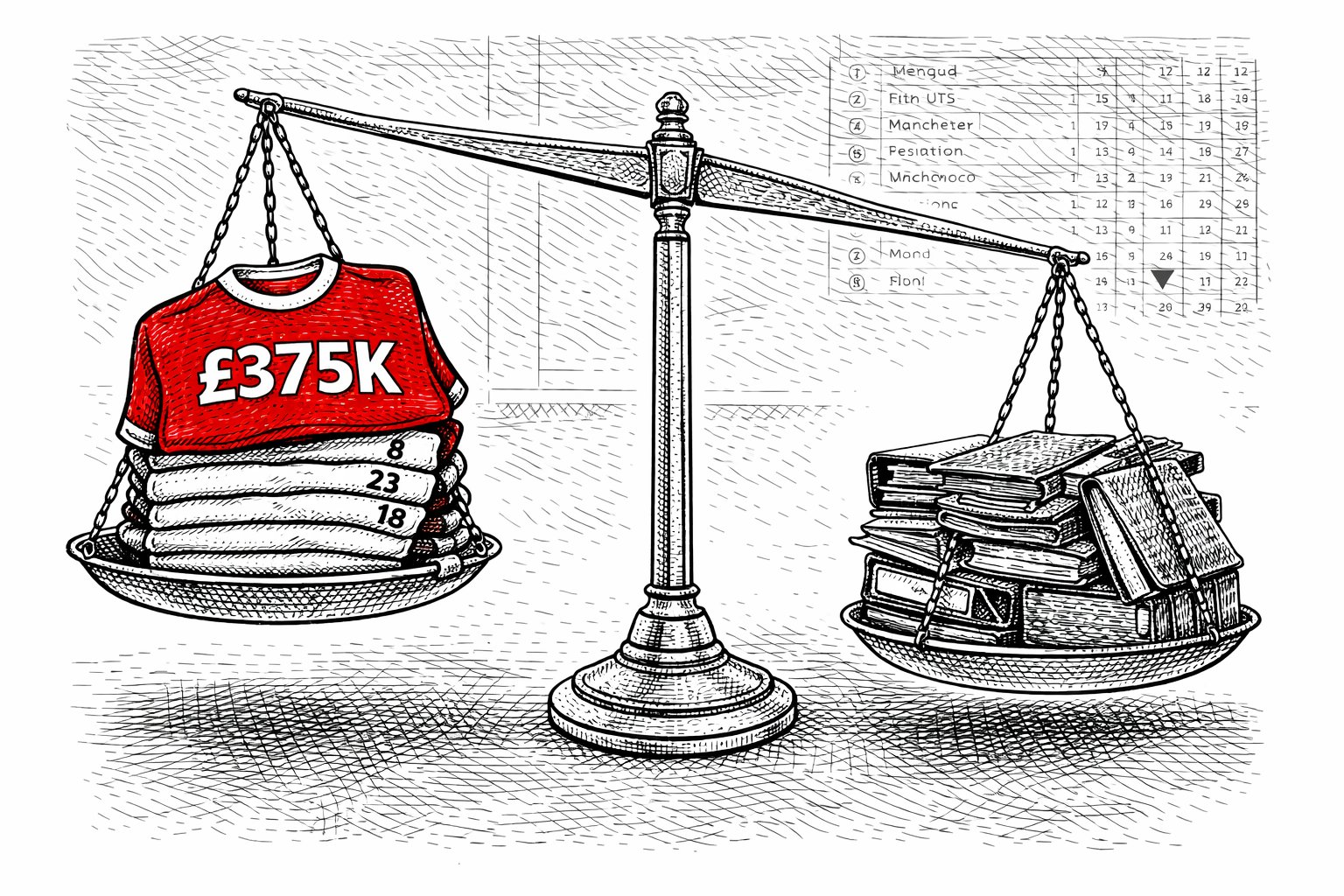
The structural consequence of high wages attached to underperforming players is illiquidity: clubs are unable to sell players whose wages potential buyers are unwilling to match. ESPN reported that a Premier League club enquired about a loan for Scott McTominay, only to withdraw when told they would have to cover a six-figure weekly salary. De Gea, earning £375,000 per week, ultimately departed as a free agent in June 2023 when United declined to extend on comparable terms. Jadon Sancho, on £350,000 per week, was loaned to Chelsea rather than sold outright.16
The pattern across the post-Ferguson period: high fees paid to acquire players → high wages to retain or attract them → below-expectation performance → inability to sell without absorbing losses → contract runs to natural expiry or costly termination.
| Player | Reported wages | Contract period | Exit |
|---|---|---|---|
| Alexis Sanchez | £350k/week | 2018–2020 | Terminated Oct 2020, 5 goals |
| David de Gea | £375k/week | 2019–2023 | Free agent Jun 2023, renewal rejected |
| Paul Pogba | £290k/week | 2016–2022 | Free agent Jul 2022, second free exit |
| Jadon Sancho | £350k/week | 2021–2025 | Loaned to Chelsea; sold 2025 |
| Casemiro | £350k/week | 2022–present | Ongoing, decline from 2023 |
Non-Player Headcount and the INEOS Restructuring
When INEOS completed its investment in February 2024, Manchester United employed 1,112 people – described by multiple sources as the largest staff of any Premier League club. The INEOS operational review concluded that this headcount "does not reflect their current performance level on the field."19
The redundancy programme proceeded in phases. In July 2024, up to 250 positions were placed at risk across all departments except the Manchester United Foundation. A second round of 150–200 redundancies was announced in February 2025. A third round of approximately 200 further cuts followed in May 2025. In aggregate, approximately 450 or more employees lost their positions – representing approximately one-third of the pre-INEOS workforce.21
The academy was among the first areas affected in July 2024. According to reports in Goal.com and The Sun, seven academy staff – including three long-serving employees – were among the first informed, and the announcement reportedly caused significant distress among young players who had returned to pre-season.22
The combined effect of performance bonus reductions (Europa League vs Champions League) and headcount reduction reduced the FY2024-25 wage bill by £51.5 million year-on-year per Sportcal's analysis of the 20-F.8
Performance-Linked Wage Clauses
Manchester United's player contracts include clauses that reduce wages materially when the club fails to qualify for European competition. Swiss Ramble and United in Focus reported that player wages fell 15–25% following the club's failure to qualify for Europe after the 2024–25 season. André Onana, whose wages were subject to such a reduction, subsequently sought a new contract to restore his compensation, and ultimately departed to Trabzonspor when terms could not be agreed.25
This mechanism creates a direct financial link between league position and non-playing staff costs: Champions League qualification generates both broadcast revenues and higher player bonuses; absence from European competition reduces both. The wage bill's sensitivity to European qualification is a structural feature of the current contract framework rather than a discretionary management decision.
Premier League Comparative Context
In 2018/19, Manchester United's £332 million wage bill exceeded both Manchester City (reported at approximately £315 million) and Liverpool (approximately £310 million) — creating a notable inversion: the club with the highest wage bill in the division finished sixth. By 2022/23, City had moved ahead at approximately £413 million, followed by Liverpool (£386 million), United (£365 million), Chelsea (£338 million), and Arsenal (£328 million).C
The 2024/25 restructuring materially altered United's relative position. With £313 million in employee benefit expenses, United ranked approximately fifth among Premier League clubs. For the first time since the Premier League's formation in 1992, Manchester United's total wage bill fell below Arsenal's — a marker of the extent to which the competitive wage hierarchy in English football had shifted during the post-Ferguson period.C
Football finance analyst Kieran Maguire identified a structural constraint on wage reduction at clubs of United's profile: players who joined as a "destination" at 22 or 23 and underperformed have few equivalent options elsewhere. "The only step is down. So trying to persuade those players to take a pay cut is difficult."D
Wages Against League Position
In FY2024-25, Manchester United's wage bill of £313 million represented approximately the fifth-largest in the Premier League while the club finished 15th – the lowest finishing position in the league's history.27 In FY2021-22, the club held the highest wage bill in English football (£384 million) while finishing sixth. In FY2018-19, the first year the bill reached £332 million, the club finished sixth. The pattern of high wage expenditure failing to produce proportionate league positions is consistent across multiple seasons.
This divergence is addressed separately in the Net Transfer Spend entry, which examines the relationship between gross transfer expenditure and squad quality. This entry documents only the aggregate wage cost and its composition.
Summary
Manchester United's total wage bill grew from £232 million in FY2015-16 to £384 million in FY2021-22 – a 65% increase over six seasons – before being reduced to £313 million by FY2024-25 through a combination of performance bonus reductions and INEOS-led non-player headcount cuts. The club's wages-to-revenue ratio peaked at approximately 55% in FY2023-24 and reduced to approximately 47% in FY2024-25.
Player wages estimated at approximately £171–196 million per season in recent years represent roughly 50–60% of total employee benefit expenses, with non-player staff costs accounting for the remainder. The non-player component was substantial enough to make Manchester United's overall headcount (1,112 at INEOS arrival) the largest in the Premier League – a position that INEOS's operational review concluded was disproportionate to the club's current performance level.
The player wage structure was inflated from 2018 onwards through high-profile contracts that created successive benchmarks – the Sanchez ceiling, the de Gea extension, the Pogba renewal – leaving the club with a wage bill that reduced the liquidity of its own transfer market. High-wage underperformers could not be sold to clubs unwilling to match the salary commitment, and several departed as free agents or at a cost below their initial transfer fee.
This entry documents observed wage figures, headcount data, and reported contract values. It does not assess whether the wages were justified, or the causes of individual player underperformance; those questions are addressed in the Net Transfer Spend and Governance entries.
References
- 1.Swiss Ramble (2016). Manchester United – Power In The Darkness. swissramble.blogspot.com
- 2.Swiss Ramble (2018). Manchester United 2017-18 financial analysis thread. threadreaderapp.com
- 3.Give Me Sport / Swiss Ramble (2019). Manchester United's wage bill is the highest ever reported by a Premier League club. givemesport.com
- 4.United in Focus / Swiss Ramble (2025). Man United's wage bill explained as Ineos cost-cutting makes £52m impact. unitedinfocus.com
- 5.Swiss Ramble (2022). European Wages 2021/22. swissramble.substack.com
- 6.Swiss Ramble (2024). Manchester United Finances 2023/24. swissramble.substack.com
- 7.United in Focus / Swiss Ramble (2025). Man United's wage bill explained as Ineos cost-cutting makes £52m impact. unitedinfocus.com
- 8.Sportcal / GlobalData (2025). Man Utd set new revenue record, cut losses significantly in 2025 earnings. sportcal.com
- 9.Capology (2025). 2024-2025 Manchester United FC Salaries and Contracts. capology.com
- 10.Capology (2024). 2023-2024 Manchester United FC Salaries and Contracts. capology.com
- 11.Spotrac (2024). 2024-25 Manchester United F.C. Payroll Table. spotrac.com
- 12.The Sun (2019). Man Utd's 2019-20 salary list revealed. the-sun.com
- 13.manunited.uk (2025). How Alexis Sanchez led to Jadon Sancho: The Deal That Broke Manchester United. manunited.uk
- 14.The People's Person (2025). Top 10 Highest-Paid Manchester United Players Ever. thepeoplesperson.com
- 15.The People's Person (2025). Top 10 Highest-Paid Manchester United Players Ever. thepeoplesperson.com
- 16.ESPN (2023). Why De Gea is emblematic of Man United's transfer problems. espn.co.uk
- 17.Sky Sports (2019). Manchester United have created their own problems with player wages, says Bryan Robson. skysports.com
- 18.Football365 / Inside World Football (2024–25). Manchester United headcount and redundancy coverage. football365.com
- 19.Sky Sports (2024). Manchester United set to make up to 250 staff redundant. skysports.com
- 20.ITV News Granada / ESPN (2025). Manchester United announce further redundancies with up to 200 jobs set to be lost. itv.com
- 21.Inside World Football (2025). Fresh redundancies underway as Manchester United cut costs. insideworldfootball.com
- 22.Goal.com (2024). Sir Jim Ratcliffe's brutal Man Utd job cuts 'left children in tears'. goal.com
- 25.United in Focus / Swiss Ramble (2025). Man United's wage bill explained as Ineos cost-cutting makes £52m impact. unitedinfocus.com
- B.Swiss Ramble / Deloitte (various). Manchester United wage bill 2005/06 £85.4m; 2007/08 £121m. Cited across multiple Swiss Ramble annual analyses and Deloitte Football Money League reports. swissramble.blogspot.com
- C.Swiss Ramble / Deloitte (2024). PL wage bill comparisons 2018/19 and 2022/23; Arsenal overtaking United 2024/25. Cited in Swiss Ramble Substack and Deloitte Annual Review of Football Finance. swissramble.substack.com
- D.Kieran Maguire, University of Liverpool (cited in wages-bill entry). Structural challenge of wage reduction at destination clubs. Multiple media citations 2023–25.
- A.BBC Verify (2025). How the Glazer family cost Manchester United £1.2bn. £125m in director compensation since 2012; ~£63m attributed to Glazer family directors. bbc.co.uk/sport
- 27.United in Focus / Swiss Ramble (2025). Man United's wage bill explained. unitedinfocus.com
- B.Swiss Ramble / Deloitte (various). Manchester United wage bill 2005/06 £85.4m; 2007/08 £121m. Cited across multiple Swiss Ramble annual analyses and Deloitte Football Money League reports. swissramble.blogspot.com
- C.Swiss Ramble / Deloitte (2024). PL wage bill comparisons 2018/19 and 2022/23; Arsenal overtaking United 2024/25. Cited in Swiss Ramble Substack and Deloitte Annual Review of Football Finance. swissramble.substack.com
- D.Kieran Maguire, University of Liverpool (cited in wages-bill entry). Structural challenge of wage reduction at destination clubs. Multiple media citations 2023–25.
- A.BBC Verify (2025). How the Glazer family cost Manchester United £1.2bn. £125m in director compensation since 2012 IPO; ~£63m attributed to Glazer family directors. bbc.co.uk