Overview
Manchester United plc's governance structure is defined by two interlocking mechanisms: a dual-class share system that permanently concentrates voting power in the hands of the Glazer family, and a board composition that has, for the entirety of the ownership period from 2005 through 2024, been dominated by family members without independent director counterbalance.
The club was taken private in May–June 2005 through a leveraged buyout executed via the family's holding vehicle Red Football Ltd, which acquired 98% of shares and subsequently delisted Manchester United from the London Stock Exchange.1 When the club relisted on the New York Stock Exchange in August 2012, it introduced a dual-class share structure that institutionalised majority voting control as a permanent feature of the company's constitution.4
From February 2024, the structure has been further complicated by a governance arrangement in which INEOS – a 27.7% minority investor – exercises delegated responsibility for all football operations, while the Glazer family retains majority financial, corporate, and voting authority.
Acquisition and Corporate Structure
The 2005 acquisition was executed through a series of holding entities. The Glazer family borrowed approximately £540 million from three New York hedge funds – Citadel, Och-Ziff Capital Management, and Perry Capital – with between £265 million and £275 million secured directly against Manchester United's assets.3 The resulting debt was incorporated onto the club's own balance sheet, meaning the cost of the family's acquisition was borne by the acquired institution's revenues rather than by the family's personal capital.
Red Football Ltd served as the principal holding company through which the Glazer family exercised ownership from 2005 through the 2012 IPO. In August 2017, Red Football LLC distributed all Class B shares equally among the six Glazer children. Each sibling holds their allocation through an individual irrevocable exempt trust.5
Dual-Class Share Structure
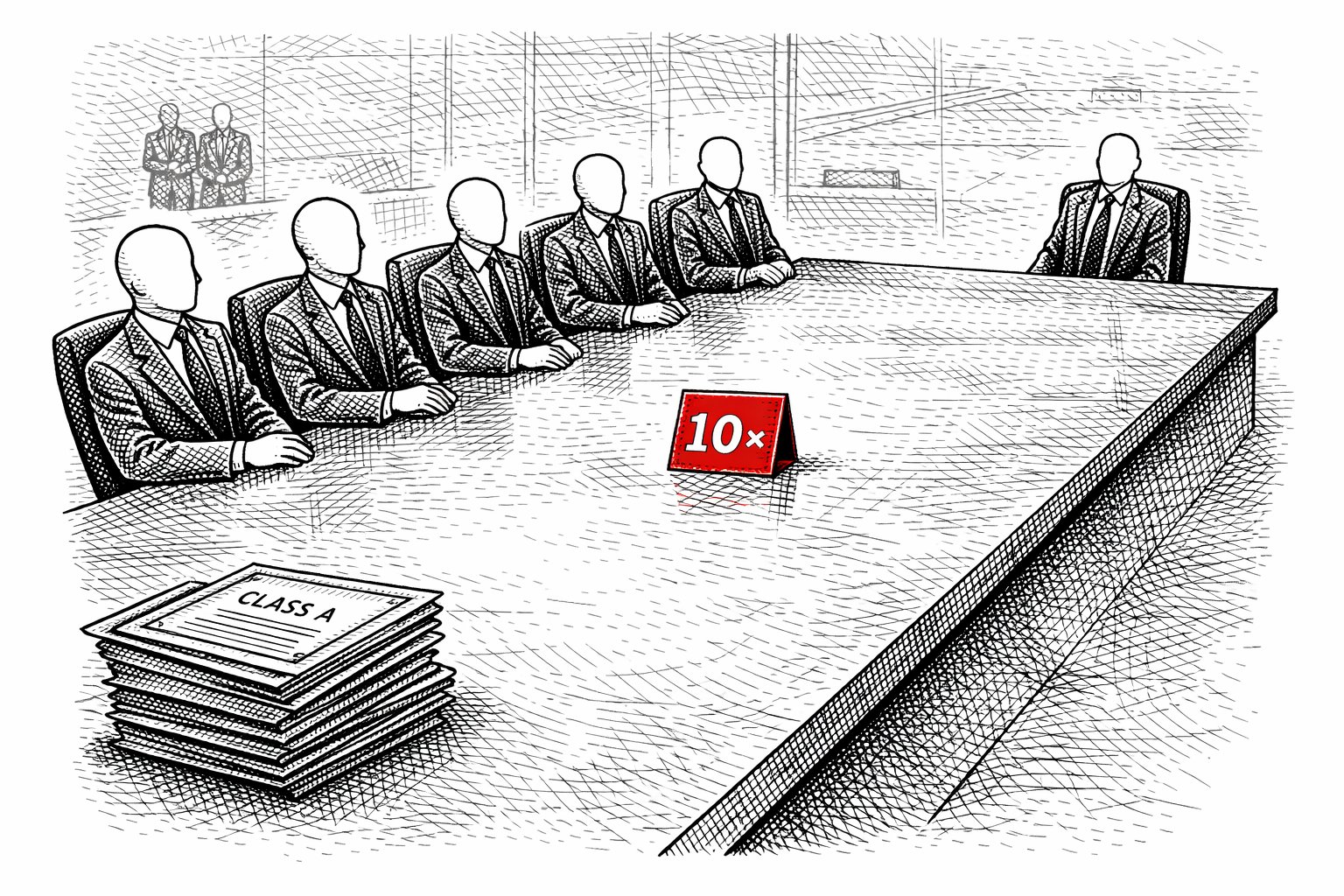
The IPO prospectus filed with the SEC in August 2012 specified that Class A ordinary shares each carry one vote and are not convertible into any other class. Class B ordinary shares each carry ten votes and are convertible into one Class A share at any time at the holder's election – but cannot be acquired by outside investors.4
At the time of IPO, the Glazer family held approximately 120 million Class B shares, generating approximately 1.2 billion votes against approximately 40 million votes from the publicly traded Class A float – representing approximately 97% of total voting control.5
A structural protection embedded in the company's Articles of Association provides that if any Class B share remains outstanding during a change-of-control event, the Glazer family automatically retains a minimum 67% voting majority regardless of how many Class A shares have been sold. The family could therefore divest virtually all economic interest whilst retaining absolute blocking power over any corporate transaction.5
| Share Class | Votes per Share | Publicly Traded | Convertible? | Primary Holders |
|---|---|---|---|---|
| Class A | 1 | Yes (NYSE: MANU) | No (cannot convert upward) | Public investors; institutional holders |
| Class B | 10 | No | Yes – to Class A at holder's election | Glazer family (individual trusts); INEOS acquired 25% of Class B in 2024 |
Board Composition (2005–2025)
From the 2005 takeover through to the 2024 INEOS investment, Manchester United's board was composed almost entirely of Glazer family members. Joel and Avram Glazer have served as Executive Co-Chairmen since the 2012 IPO; Kevin, Bryan, Darcie, and Edward Glazer serve as non-executive directors.6
The board has never during this period included a majority of independent non-executive directors. As a foreign private issuer (FPI) listed on the NYSE, Manchester United is permitted to follow UK home country governance practices rather than the more stringent US domestic requirements, provided it discloses these differences in its annual Form 20-F. This is the regulatory mechanism through which a Glazer-family-dominated board has remained consistent with NYSE listing obligations across the entire period 2012–2025.14
As at 2025, the board includes one director identified as independent: John Hooks, whose professional background is in luxury fashion (Valentino, Giorgio Armani). No director with a background in professional football governance, sports management regulation, or English football operations serves in a non-executive capacity.6
| Director | Role | Category | Background Note |
|---|---|---|---|
| Joel Glazer | Executive Co-Chairman | Glazer family | Co-Chairman, Tampa Bay Buccaneers; American University |
| Avram Glazer | Executive Co-Chairman | Glazer family | Former CEO, Zapata Corporation; law degree, American University |
| Kevin Glazer | Non-Executive Director | Glazer family | Chairman, Glazer Properties; Ithaca College |
| Bryan Glazer | Non-Executive Director | Glazer family | Co-Chairman, Tampa Bay Buccaneers; law degree, Whittier College |
| Darcie Glazer Kassewitz | Non-Executive Director | Glazer family | President, Tampa Bay Buccaneers Foundation; law degree, Suffolk Law |
| Edward Glazer | Non-Executive Director | Glazer family | Co-Chairman, Tampa Bay Buccaneers; Ithaca College |
| John Hooks | Independent Director | Independent NED | 40+ years luxury fashion; Oxford University |
| Omar Berrada | Chief Executive Officer | Executive (INEOS appointee) | Former Chief Football Officer, City Football Group; joined July 2024 |
| Roger Bell | Chief Financial Officer | Executive (INEOS aligned) | Former CFO, INEOS Sport; joined May 2024 |
Executive Leadership Succession
The Glazer family did not appoint a traditional chief executive at the point of the 2005 takeover. David Gill, who had served as CEO from 2003 under the previous PLC structure, continued in post until the end of the 2012–13 season – a departure that coincided with Sir Alex Ferguson's retirement.7
Ed Woodward, who had advised the Glazer family on the 2005 leveraged buyout while at JP Morgan, joined the club in 2007 to lead commercial and media operations. He was appointed to the board and named executive vice-chairman in 2012, subsequently assuming the effective chief executive role following Gill's departure – without formally holding the CEO title.78 Woodward's tenure (2013–2022) coincided with four managerial dismissals and a sustained absence of major domestic league trophies. ESPN reported that sustained criticism centred on the combination of commercially-oriented leadership with executive responsibility for football decisions, and that Woodward resisted the appointment of a director of football until early 2021.7
Woodward announced his resignation in April 2021 following Manchester United's failed attempt to join the European Super League – a competition Joel Glazer had signed the club into as one of the founding participants.9 Richard Arnold succeeded Woodward in February 2022 with the same accountancy background, and departed in November 2023 during the ownership process. Omar Berrada – recruited from City Football Group by INEOS – was appointed CEO from July 2024.6
The INEOS Transaction and the Resulting Governance Structure
On 24 December 2023, Manchester United plc announced that Sir Jim Ratcliffe's vehicle Trawlers Limited would acquire 25% of the company's Class B shares and up to 25% of its Class A shares at $33 per share, with an additional $300 million to be injected for stadium and infrastructure investment. The transaction was completed in February 2024.10
Unusually, the transaction assigned INEOS operational responsibility for all football operations – men's, women's, and Academy – as a specific contractual delegation from the board, despite INEOS holding a minority position in both economic interest and voting rights. INEOS received two seats on the Manchester United PLC board and two seats on the Manchester United Football Club board.1012
The formal Governance Agreement, filed with the SEC as a Form 6-K on 26 December 2023, confirmed that the minority shareholder (INEOS) and majority shareholder (Glazer family) each have the right to nominate up to two members of the Company Board, with the majority shareholder appointing the remainder. The agreement also includes a drag-along provision, operative 18 months after closing, under which the company may compel INEOS into a full sale; and customary tag-along and preemptive rights for the minority holder.11
The PLC board seats were taken by John Reece (INEOS shareholder) and Rob Nevin (Chairman, INEOS Sport). The football club board seats were taken by Sir Dave Brailsford (INEOS Director of Sport) and Jean-Claude Blanc (former executive at Juventus and Paris Saint-Germain).12 By June 2025, Brailsford had stepped back from his Manchester United duties, returning to wider INEOS sporting responsibilities. Dan Ashworth, appointed as sporting director in early 2024 at a combined cost of approximately £9.1 million, also departed – leaving a management structure with an average executive tenure of approximately 1.8 years.15
| Domain | Controlling Party | Basis |
|---|---|---|
| Football operations (men's, women's, Academy) | INEOS (27.7% shareholder) | Board delegation, December 2023 agreement |
| Corporate strategy and financial decisions | Glazer family (majority) | Majority Class B vote |
| Board nominations (majority) | Glazer family | Governance Agreement: majority nominates remainder |
| Board nominations (minority, 2 seats) | INEOS | Governance Agreement: minority nominates up to 2 |
| Change-of-control blocking power | Glazer family | Structural: 67% minimum vote while any Class B exists |
| Commercial and revenue decisions | Glazer family | Majority corporate authority |
| CEO appointment | INEOS (in consultation with Glazers) | Berrada appointment 2024: INEOS driving force (Sky Sports) |
Foreign Private Issuer Status and Governance Exemptions
Manchester United plc is incorporated in the Cayman Islands and operates as a foreign private issuer (FPI) under SEC rules. This classification exempts the company from the NYSE's domestic corporate governance requirements that would otherwise apply – including the requirement that a majority of board members be independent, and that compensation and nominating committees be composed entirely of independent directors.14
As an FPI, Manchester United is required to maintain an audit committee satisfying SEC Rule 10A-3 but may otherwise follow UK home country governance practices, provided it discloses significant divergences from NYSE domestic standards in its annual Form 20-F. This is the mechanism through which a six-member Glazer-family-dominated board has remained consistent with the company's NYSE listing obligations continuously since 2012.14
Minority Shareholder Concerns
The dual-class share structure has been a persistent concern for Class A public investors. In November 2023, Lindsell Train – at the time a significant institutional Class A holder – stated publicly that investors had been left without adequate information about the ownership process. The fund manager noted that the dual-class structure posed specific risks for minority investors, as the supervoting Class B shares held by the Glazers did not trade on the open market and no formal consultation process had been established with public shareholders during the strategic review.17
The 2023 Governance Agreement included customary tag-along and preemptive rights for the minority shareholder (INEOS). No equivalent structural protections for the public Class A float were established as part of the transaction arrangements.11
Supporters Trust and Fan Governance
Manchester United Supporters Trust (MUST) welcomed Ratcliffe's 2024 investment but raised structural questions in a public statement, noting uncertainty over how an institution could meaningfully place its core sporting operations under the authority of a minority stakeholder, and calling on the club to explain how the new dual-authority structure would function in practice.16
No formal fan representation mechanism – whether advisory, observer, or board seat – has existed at Manchester United during the period 2005–2025. No Supporters Trust representative has held any board or formal advisory position.
The Football Governance Act 2025
The Football Governance Act received Royal Assent in July 2025, establishing an Independent Football Regulator (IFR) for English football. The Act introduces a mandatory licensing regime for Premier League clubs, with compliance conditions across financial regulation, fan engagement, and club heritage preservation.18
Under the Act's fan engagement threshold, clubs are required to maintain adequate means of consulting supporters on strategic direction, business priorities, ticket prices, and proposed ground relocation. The Regulator has the power to compel clubs to establish democratically selected fan representative groups, rather than allowing clubs to self-select their consultation counterparts.1819 The Act also introduces strengthened ownership and directors' tests, with the IFR empowered to assess whether individual owners and officers have appropriate qualifications, experience, and fitness – provisions applicable to all Premier League clubs including Manchester United from the date of regulatory implementation.19
Summary
Manchester United's governance architecture across the period 2005–2025 is characterised by the following structural features: a dual-class share system assigning ten votes per share to Glazer-held Class B stock versus one vote for public Class A investors; a board in which Glazer family members have constituted a majority throughout, with one independent non-executive director; an executive succession drawn from commercial rather than football management backgrounds across the key 2013–2022 period; and, from February 2024, a delegation of sporting operations to a minority investor while the majority owner retains corporate and voting authority.
The club's foreign private issuer classification has permitted this structure to coexist with NYSE listing requirements without formal breach. The Football Governance Act 2025 introduces for the first time an external regulatory framework – the Independent Football Regulator – with powers to assess club ownership fitness, require structured fan engagement, and enforce compliance. These provisions apply directly to Manchester United as a Premier League club.
This entry documents observed structural features. It does not assess the consequences of those features for sporting or financial outcomes; those questions are addressed in related entries.
Cross-References
References
- 1.Wikipedia (2023). Glazer ownership of Manchester United. https://en.wikipedia.org/wiki/Glazer_ownership_of_Manchester_United
- 2.Al Jazeera (2023). Timeline: The Glazers' troubled ownership of Manchester United. https://www.aljazeera.com/sports/2023/8/14/timeline-glazer-family-ownership-manchester-united-sale-process
- 3.Mill Wood Finance (2024). How did the Glazers buy Manchester United? https://millwoodfinance.com/how-did-the-glazers-buy-manchester-united/
- 4.SEC EDGAR (2012). Manchester United plc Form 424B4 IPO Prospectus. https://www.sec.gov/Archives/edgar/data/1549107/000104746912008161/a2210672z424b4.htm
- 5.American Red Devils (2020). How The Glazers Cashed In On Manchester United Stock. https://americanreddevils.com/how-the-glazers-cashed-in-on-manchester-united-stock/
- 6.Manchester United plc Investor Relations (2025). Board of Directors. https://ir.manutd.com/corporate-governance/board-of-directors.aspx
- 7.ESPN (2022). Ed Woodward to leave Man United executive vice-chairman role at end of January. https://www.espn.com/soccer/story/_/id/37624148/ed-woodward-leave-man-united-executive-vice-chairman-role-end-january
- 8.Wikipedia (2024). Ed Woodward. https://en.wikipedia.org/wiki/Ed_Woodward
- 9.Sky Sports (2021). Ed Woodward resigned over Super League plans. https://www.skysports.com/football/news/11667/12283715/ed-woodward-man-utd-executive-vice-chairman-resigned-over-belief-he-could-not-support-super-league-plans
- 10.Manchester United plc (2023). Man Utd reaches agreement for Sir Jim Ratcliffe to acquire 25% shareholding. https://www.manutd.com/en/news/detail/man-utd-reaches-agreement-for-sir-jim-ratcliffe-to-acquire-25-per-cent-shareholding
- 11.SEC EDGAR – Form 6-K (2023). Governance Agreement dated December 24 2023. https://www.sec.gov/Archives/edgar/data/1549107/000110465923129240/tm2333645d2_6k_htm
- 12.Inside World Football (2024). Ratcliffe and Ineos complete £1.03bn Man Utd buy-in and take control of operations. https://www.insideworldfootball.com/2024/01/02/ratcliffe-ineos-complete-1-03bn-man-utd-buy-take-control-operations/
- 13.DCF Modeling (2025). Manchester United plc – history, ownership, mission, how it works & makes money. https://www.dcfmodeling.com/blogs/history/manu-history-mission-ownership
- 14.Norton Rose Fulbright (2025). US SEC issues concept release on foreign private issuer eligibility. https://www.nortonrosefulbright.com/en/knowledge/publications/643484aa/us-securities-and-exchange-commission-issues-concept-release-on-foreign-private-issuer-eligibility
- 15.GB News (2025). Manchester United's head of football operations 'to step back' amid boardroom chaos. https://www.gbnews.com/sport/football/manchester-united-sir-dave-brailsford-step-back-boardroom-chaos
- 16.Manchester United Supporters Trust (2024). MUST responds to INEOS announcement taking minority stake in MUFC. https://www.imust.org.uk/Blog/Entry/must-respond-to-ineos-announcement-taking-minority-stake-in-mufc
- 17.The Irish Times / Financial Times (2023). Manchester United investors left in dark over club's fate, says top shareholder. https://www.irishtimes.com/business/2023/11/07/manchester-united-investors-left-in-dark-over-clubs-fate-says-top-shareholder/
- 18.Sky Sports / GOV.UK (2025). Football Governance Act becomes law; Independent Football Regulator to begin work. https://www.skysports.com/football/news/11095/13399777/independent-football-regulator-to-begin-work-this-year-as-football-governance-act-becomes-law
- 19.Morgan Lewis (2024). New Football Governance Bill Relaunched in UK Parliament. https://www.morganlewis.com/pubs/2024/11/new-football-governance-bill-relaunched-in-uk-parliament