Overview
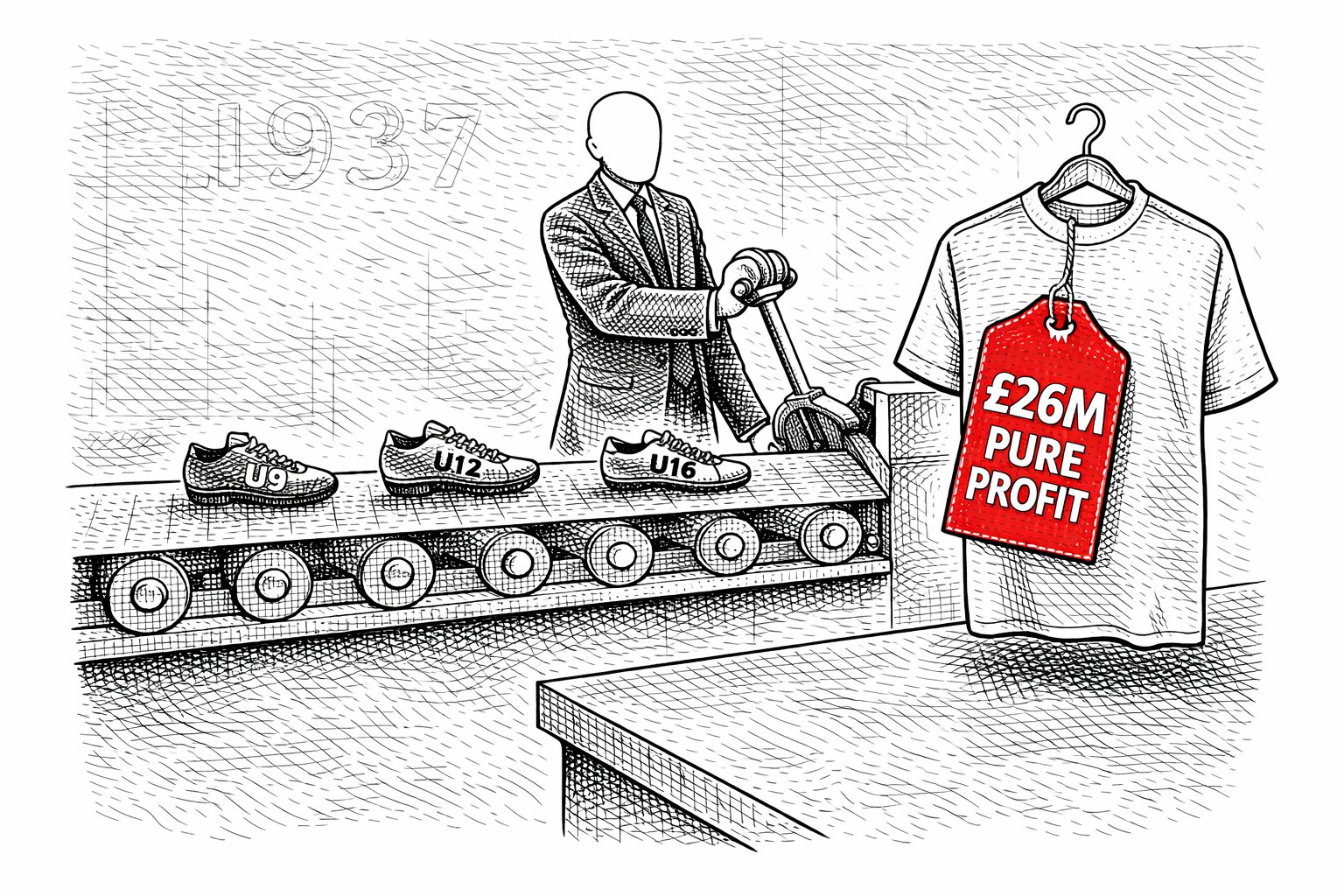
Manchester United's youth academy occupies a distinctive position in the club's financial and institutional history. As a sporting institution, it is the longest-running source of first-team talent in the club: every matchday squad since 30 October 1937 has included at least one homegrown player — a sequence of more than 4,000 competitive games spanning 88 years.1 As a financial asset, academy graduates represent the most PSR-efficient category of player available: when sold, the entire fee counts as pure profit, with no acquisition cost to deduct.7
These two functions — institutional heritage and financial instrument — increasingly pull in different directions under the conditions of the post-2022 ownership. INEOS redundancies in July 2024 removed at least seven members of the academy coaching staff, including individuals credited with developing Marcus Rashford and other first-team players. In the same summer, 13 homegrown players were sold or released in a single window. Academy Director Nick Cox, who oversaw the programme for a decade, departed to Everton in September 2025.
Heritage and Historical Output
The academy's most famous cohort — the Class of '92, comprising Ryan Giggs, Paul Scholes, Gary Neville, David Beckham, Nicky Butt, and Phil Neville — emerged under Sir Alex Ferguson and underpinned the most successful domestic period in the club's modern history, contributing to multiple Premier League titles and the 1999 Treble.3 The tradition stretches further: when Manchester United became the first English club to win the European Cup in 1968, all four goals against Benfica were scored by homegrown players.4
The unbroken 88-year matchday sequence began on 30 October 1937 at Craven Cottage. Since that date, the club has produced over 258 players who made first-team competitive appearances — a figure tracked by club historians and verified in official club records.2 The most recent debutants include Kobbie Mainoo, Alejandro Garnacho, Chido Obi, Toby Collyer, and Ayden Heaven.
The Financial Mechanics: Academy Graduates and PSR
Under the Premier League's Profit and Sustainability Rules, clubs can sustain cumulative losses of no more than £105 million over a rolling three-year period. The accounting treatment of player sales is central to managing this limit: transfer fees received are recorded as profit, offset by the player's remaining book value — the unamortised portion of the original transfer fee.8
Academy graduates are the exception. Because the club paid no transfer fee to acquire them, their book value is zero. The entire fee received from their sale is therefore recorded as pure profit — making homegrown players the most PSR-efficient assets a club can possess. Every pound of the transfer fee counts in full. Nothing is deducted.7
This mechanism did not begin with PSR. Exhibit Y.2 documents 20 seasons of academy graduate sales against annual pre-tax results, and the pattern it reveals is more complicated than a simple modern story. The academy has always been a financial asset — it simply has not always been an urgent one.
In FY2008 — the deepest year of the LBO-era losses, when the club posted a pre-tax loss of approximately £84 million — Manchester United sold Gerard Pique to Barcelona for £6 million, Kieran Richardson to Sunderland for £5.5 million, and Giuseppe Rossi to Villarreal for £6.7 million. Three academy graduates generating £21 million in a single window, at a moment of acute financial stress, with no PSR framework in existence. The money barely registered in the narrative of that period. It should have.
In FY2009, the club returned to pre-tax profit — but not because of the academy. Cristiano Ronaldo was sold to Real Madrid for £80 million. Ronaldo was purchased from Sporting Lisbon for £12.24 million in 2003. His book value in June 2009 was effectively zero, making his sale also pure profit. But he was not an academy graduate — he was an external acquisition whose full amortisation happened to align with a crisis year. Without the Ronaldo sale, FY2009 would have been a £32 million pre-tax loss. The academy contributed approximately £9 million in genuine homegrown sales that year. It was not enough on its own.
Between FY2011 and FY2018 — the return to periodic profitability — academy graduate sales ticked along at between £5 million and £26 million per year. Players departed for modest fees, their exits unremarkable in the context of a club that was broadly financially stable. The pure-profit accounting advantage existed but was not structurally needed.
The four years from FY2019 to FY2022 tell a different story. Losses mounted — approximately £78 million, £92 million, £53 million, and then £33 million in successive seasons. In those same four years, academy graduate sales were effectively zero. Lingard departed as a free agent. Pogba departed as a free agent. No meaningful PSR-pure-profit transactions occurred. The losses accumulated in silence, without the release valve that the academy could, in theory, have provided. Manchester United's cumulative losses exceeded £400 million across the six seasons to 2024-25.9
By FY2024, the pressure was acute. The mechanism that had existed quietly for two decades was now actively needed — and activated.
The 2024 Summer: 13 Players, Pure Profit, and the Aftermath
In the summer of 2024, Sir Jim Ratcliffe's first transfer window as co-owner, Manchester United sold or released 13 homegrown players. The two most significant transactions were the sale of Scott McTominay to Napoli for approximately £26 million and Mason Greenwood to Marseille for up to £26.7 million — both recording as pure profit in the club's accounts.9
Journalist Miguel Delaney reported that the McTominay decision was not made with enthusiasm: "No one at the club was exactly thrilled about it." The dual rationale was PSR — his sale counted in full as pure profit — and the player's own rising wage demands at contract renewal, which the club was unwilling to meet. Erik ten Hag, according to the same report, would have preferred to keep him.10
The subsequent record of those players illustrates the tension in the decision. McTominay won the Serie A MVP award in his debut season at Napoli, helping fire the club to the Scudetto while scoring 12 league goals. Multiple sources described the sale as one of the most significant transfer misjudgements of the period. Greenwood scored 22 goals at Marseille in their Champions League-qualifying campaign. Manchester United retained a 10% sell-on on McTominay and a variable 40–50% sell-on on Greenwood, providing some future participation in value created elsewhere.1112
Alejandro Garnacho followed in August 2025, sold to Chelsea for £40 million — the largest upfront fee ever received by Manchester United for an academy graduate, and itself a pure-profit transaction under PSR rules.13
| Player | Destination | Fee | Subsequent outcome | Sell-on retained |
|---|---|---|---|---|
| Scott McTominay | Napoli (2024) | ~£26m | Serie A MVP; Scudetto winner 2024-25 | 10% |
| Mason Greenwood | Marseille (2024) | up to £26.7m | 22 goals, CL qualification | 40–50% (variable) |
| Willy Kambwala | Villarreal (2024) | £10m | 21 La Liga appearances; Champions League football | Not reported |
| Alejandro Garnacho | Chelsea (2025) | £40m | Largest upfront fee for a MUFC academy graduate | 10% |
The Imputed Value: What the Academy Saves
Beyond sale proceeds, the academy generates value through a mechanism rarely captured in financial disclosures: the cost avoided by not having to buy a comparable player in the external market. An academy graduate who makes the first team on wages of £150,000 per week replaces a position that might cost £50 million in transfer fees and comparable wages from an external source.
Twenty First Group, a football analytics consultancy, estimated in 2021 that Manchester United's player costs in 2019/20 would have been approximately £60 million higher without the academy contribution — specifically citing the first-team performances of Rashford, McTominay, and Greenwood at wages well below comparable external market purchases.14 This figure is an estimate, not an audited figure, and reflects a single season. The broader principle — that first-team-ready academy graduates represent substantial imputed savings relative to external market alternatives — is consistent across analytical frameworks.
Manchester United and Arsenal were identified in a 2025 analysis by The ESK as leading the Premier League for first-team integration of homegrown talent — described as a strategy that "provides significant imputed financial savings" and represents a "strategic imperative for long-term competitive and financial health."15
INEOS, the Redundancies, and the Institutional Question
The INEOS redundancy programme of summer 2024 affected the academy disproportionately in its first wave. At least seven coaching and development staff were made redundant in July 2024, including figures credited with developing Rashford, Axel Tuanzebe, and others, some with over two decades of service.19 The timing — before young players had returned for pre-season — was characterised by one parent as "like waiting all summer and then sacking all the teachers on the first day of term, in front of the kids."21
Nick Cox, who had led the academy since approximately 2015 and oversaw its recovery to Category One standing, including the FA Youth Cup win of 2022, left the club in September 2025 to become Everton's Technical Director. In his farewell column, published on the club's official website, Cox wrote: "Custodianship is only ever temporary... the aim should be to leave our part of the club in a better place than when we arrived. With the support of so many wonderful people across the Academy over the past 10 years, we have collectively achieved that objective."20
U18 head coach Adam Lawrence also departed in summer 2025. INEOS stated publicly that the academy "remains at the heart of the club's strategy" and sought to reassure parents of academy players that further coaching cuts were not planned following the February 2025 announcement of additional redundancies elsewhere in the organisation.21 INEOS also invested in new academy signings for 2025-26, including Chido Obi, Samuel Lusale, Sekou Kone, Enzo Kana-Biyik, and Diego Leon.22
The Structural Tension: What the 20 Years Show
The chart in Exhibit Y.2 contains a finding that the financial story of this period does not usually surface. In FY2025 — for the first time in twenty years of available data — Manchester United's academy graduate pure-profit sales (approximately £59 million) exceeded the club's annual pre-tax loss (approximately £40 million). The academy, in financial terms, more than covered the year's losses.
This is not presented as a success. It is presented as a structural fact with an uncomfortable implication: the club's most PSR-efficient financial lever is now being used at the scale and frequency of a business in financial distress, not of a club investing in its future. The same academy that produced the Class of '92, that ran quietly through profitable years generating modest fees, that was never primarily a financial instrument — is now one of the primary tools by which the club manages its PSR position.
The 20-year chart also clarifies when this shift happened. It was not gradual. Between FY2019 and FY2022, losses mounted while academy sales were near-zero. The academy wasn't being used as a financial lever during those years — whether because the graduates weren't yet ready, the market wasn't right, or the club hadn't fully activated the mechanism. By FY2024, the PSR window had narrowed enough that Henderson and Elanga needed to go. By FY2025, McTominay, Greenwood, and Garnacho all followed. The dry period ended abruptly.
The same financial framework that makes academy graduates commercially valuable also creates the incentive to sell them precisely when they are becoming most useful. The imputed value of retaining a Mainoo — avoided transfer fees, lower wages, identity — is real but does not appear on the balance sheet. The £26 million from McTominay did.
The 88-year matchday sequence has been maintained throughout. The academy continues to produce first-team debutants. Whether it can continue to do both things — serve as an institutional tradition and as a PSR instrument — without the two purposes eventually degrading each other is a question the accounts do not resolve.
Summary
Manchester United's academy has always been a financial asset. In FY2008, the worst loss year of the LBO era, it generated £21 million through the sales of Pique, Richardson, and Rossi — quietly, without a PSR framework in existence. Through the profitable years of FY2011–18, it generated between £5 million and £26 million per year as a background feature of club finances. Then, for four successive years from FY2019 to FY2022, it generated almost nothing in fees as losses mounted and the release valve stayed closed.
In FY2024 and FY2025, it was opened at full pressure. Henderson and Elanga, then McTominay, Greenwood, Kambwala, and Garnacho. Approximately £94 million in academy pure-profit sales across two seasons, against a backdrop of cumulative losses exceeding £400 million over six years. In FY2025, for the first time in twenty years of available data, academy sales exceeded the annual pre-tax loss. The academy more than paid for the year.
The 88-year matchday sequence, the 258 debutants, the Class of '92, Rashford, Mainoo — these represent an institutional tradition of genuine depth. They are also, under the current financial framework, part of the same asset base being drawn down to manage the club's PSR position. Whether those two things are compatible in the long run is not a question this entry answers. It is, however, the question the 20-year chart poses.
This entry documents the heritage, financial mechanics, and the structural pattern visible across twenty seasons. It does not assess whether the decisions taken were correct. That question is addressed in part in the Net Transfer Spend and Governance entries.
References
- 1.Manchester United plc (2025). Man Utd incredible Academy landmark reaches 88 years. manutd.com
- 2.United in Focus (2026). Every single Manchester United academy graduate as Tyler Fletcher becomes number 258. unitedinfocus.com
- 3.Manchester United plc (2025). Youth team debutants. manutd.com
- 4.Manchester United plc (2022). Explained: United's incredible 85-year Academy landmark. manutd.com
- 5.Analytics FC (2024). How do you assess the value of an Academy? analyticsfc.co.uk
- 6.Social Football Summit / UEFA (2026). The Business of Football Academies. socialfootballsummit.com
- 7.Brabners (2024). Navigating the Premier League's profit and sustainability rules. brabners.com
- 8.FourFourTwo (2024). What are the Premier League's Profit and Sustainability Rules? fourfourtwo.com
- 9.Matchday Finance (2025). Manchester United Financial Results 2024/25. matchdayfinance.com
- 10.Yahoo Sports / Miguel Delaney (2024). Man United sold McTominay after he demanded increased wages. sports.yahoo.com
- 11.Fox Sports (2025). Man United accused of 'one of the biggest transfer mistakes ever' by World Cup winner. foxsports.com
- 12.Goal.com (2025). Man Utd Mason Greenwood cash injection update. goal.com
- 13.United in Focus (2025). Manchester United's most expensive transfer sales of all time. unitedinfocus.com
- 14.Twenty First Group (2021). The pitfalls when evaluating a successful academy. twentyfirstgroup.com
- 15.The ESK (2025). Premier League Academy Productivity and Profitability (2015–2025). theesk.org
- 16.Yahoo Sports (2024). Six Manchester United academy talents who could make senior breakthrough in 2024/25. sports.yahoo.com
- 17.Manchester United plc (2024). Man Utd Premier League squad for rest of 2023/24 season confirmed. manutd.com
- 19.The People's Person / The Athletic (2024). Manchester United's academy shake-up: long-serving staff face redundancies under INEOS. thepeoplesperson.com
- 20.Manchester United plc (2025). Inside the Academy: Nick Cox column reflecting on Manchester United departure. manutd.com
- 21.Goal.com (2024). Sir Jim Ratcliffe's brutal Man Utd job cuts 'left children in tears'. goal.com
- 22.United in Focus (2025). Man Utd set to lose key academy man to Everton. unitedinfocus.com
- 25.Planet Football (2025). Where are they now? Every Man Utd academy graduate sold in 2024. planetfootball.com