The Austerity Paradox
How INEOS cut costs without cutting the problem. A Glazernomics analysis of sequencing, proportionality, and whose bill this actually is.
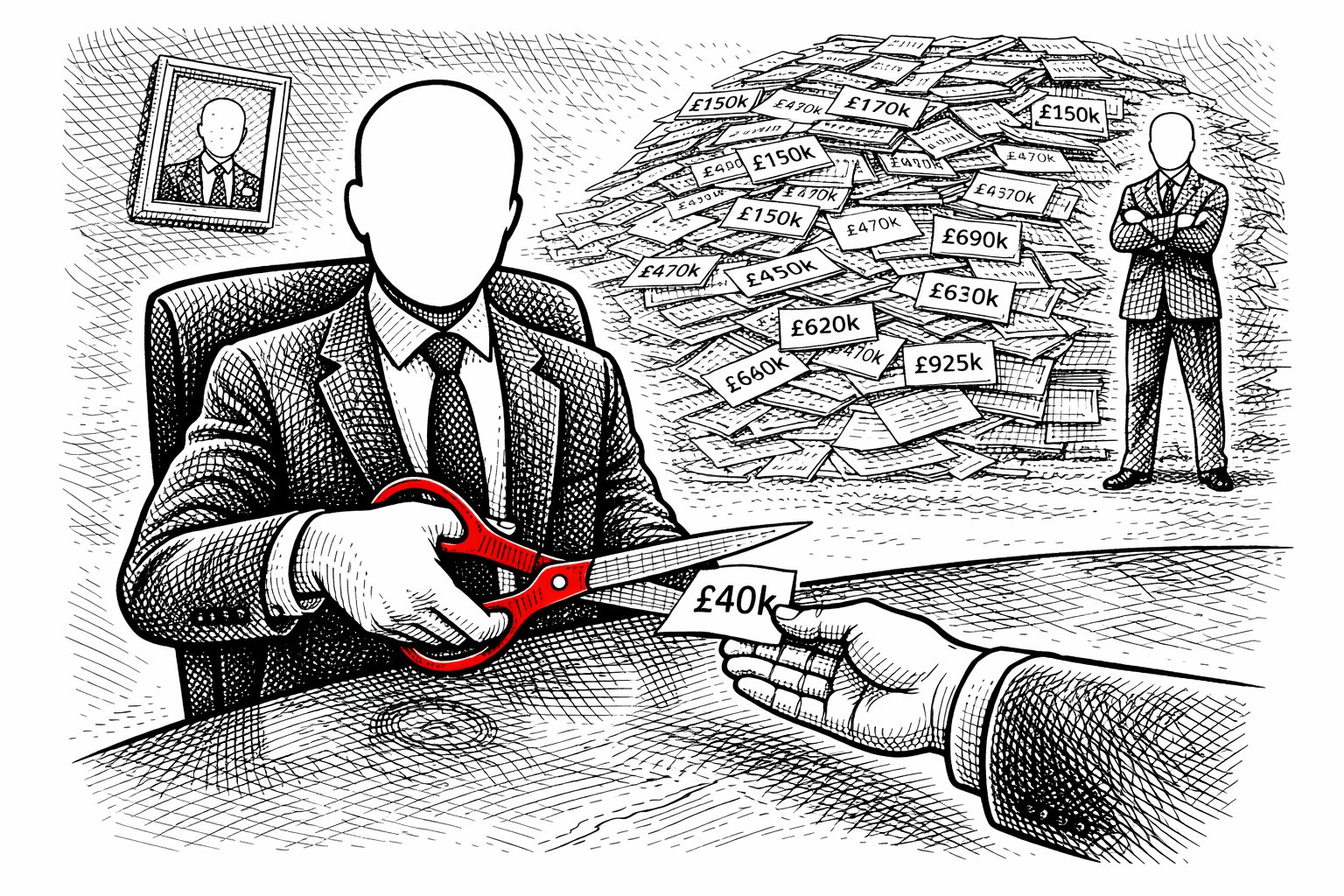
When Sir Jim Ratcliffe took operational control of Manchester United in February 2024, he inherited a club in genuine financial distress. Five consecutive years of losses. Cumulative losses of £370m. A wage bill running at £365m per year.1 Interest charges on Glazer-era debt consuming tens of millions annually. And a Profit and Sustainability Rules assessment looming like a deadline nobody wanted to discuss at board level.
The case for structural change was, by any financial standard, real. What followed was a restructuring programme that combined legitimate necessity with a remarkable talent for choosing the wrong symbolic battles first.
The Numbers Nobody Disputes
The headcount comparison is the place to start, because it is where the structural case for cuts is most clearly established. At its peak in 2023, Manchester United employed 1,112 people — the largest workforce among the Premier League's so-called Big Six by some distance.2
| Club | Staff (c.2023) | League position 2022–23 |
|---|---|---|
| Manchester United | 1,112 | 3rd |
| Liverpool | 1,005 | 5th |
| Chelsea | 788 | 12th |
| Tottenham Hotspur | 719 | 8th |
| Arsenal | 649 | 2nd |
| Manchester City | 520 | 1st (Champions) |
| Source: Daily Mail / OneFootball, July 2024.2 | ||
Manchester City, a club that had just won their third consecutive Premier League title and a Champions League, employed 520 people. Arsenal employed 649. The consultancy firm Interpath Advisory, commissioned to review United's operations after Ratcliffe's arrival, concluded that the size of the workforce did not reflect the club's performance level — eighth in the Premier League, 31 points behind City.2 On the raw numbers, the case stood.
How It Got There
The headcount did not arrive overnight. In 2012, United employed 696 people. By 2015, 813. From 2017 onwards, the number climbed steadily past a thousand.3 The trajectory broadly tracks the Glazers' commercial expansion: commercial revenue had grown from approximately £44m in 2005 to over £300m by 2023 — a commercial machine that required people to operate it.4
This matters for the attribution question. Much of the headcount growth occurred in the commercial and administrative departments built to generate the revenues the Glazers needed to service their debt and extract dividends. The sponsorship teams, content operations, and international partnership infrastructure — the same apparatus that grew United into a commercial giant — were also what drove the headcount past every rival's. The staffing level was, in considerable part, a cost of the Glazers' own model; not simply bureaucratic waste left unexamined.
The Trigger
By the time INEOS took over, the structural pressure was acute. The Premier League's Profit and Sustainability Rules permitted a maximum combined loss of £105m over three rolling seasons — a threshold United were approaching. Ratcliffe's share purchase generated approximately £35m of PSR headroom. The first round of 250 redundancies was estimated to save a further £35m per year.5 The financial case for restructuring was therefore not manufactured. It was a documented compliance requirement.
CEO Omar Berrada's statement in February 2025 was precise on this point: "We have lost money for the past five consecutive years. This cannot continue."6 On the evidence of the accounts, he was not wrong.
The Inventory
It is worth assembling the complete register of what INEOS chose to cut, because the cumulative picture is more revealing than any individual decision.
| Measure | Est. annual saving | Year |
|---|---|---|
| 250 staff redundancies — wave one | ~£35m | 2024 |
| 150–200 staff redundancies — wave two | Not disclosed | 2025 |
| Ferguson ambassadorial role ended | ~£2m | 2024 |
| Ambassador salary reductions (Robson, Cole, Irwin) | Not disclosed | 2024 |
| AFMUP charity payments ceased | £40,000 | 2024 |
| Manchester United Foundation funding reduced | ~£1m | 2025 |
| Staff free lunches ended | ~£1m | 2025 |
| Christmas party cancelled; FA Cup final travel withdrawn | Not disclosed | 2024 |
| Flat £66 match ticket rate; senior and child concessions removed | Revenue increase | 2024 |
| Sources: RTÉ Sport, ESPN, Swiss Ramble, Goal.com, Yahoo Sports.7 | ||
The Association of Former Manchester United Players (AFMUP) had received quarterly payments of £10,000 from the club since 1985. Its trustees reported that the last two payments had been withheld without notice or explanation.8 AFMUP supports former players from the pre-Premier League era, including funding funerals for those without other means. Annual cost to the club: £40,000.
The Manchester United Foundation — the club's charitable arm — was notified that its annual funding, believed to be close to £1m, would be reduced from 2025.9 The flat £66 match ticket rate eliminated all concessions for seniors and children.10 None of these decisions, according to supporter groups, was subject to prior consultation.
The Proportionality Problem
The Casemiro exchange is the moment that crystallised the disconnect.
At a staff meeting at the academy, CEO Omar Berrada announced that ending free lunches would save the club approximately £1m per year. A member of staff pointed out that this was one month's wages for Casemiro — then still on the payroll. Berrada, reported to earn approximately £4m per year, was asked whether he had considered taking a proportionate personal cut.11 INEOS did not publicly refute the substance of the exchange. The transcript circulated.
£40,000 ÷ £313,000,000. The annual donation to the Association of Former Manchester United Players — withheld without notice — represented less than two weeks of the club's outstanding debt interest charges, and roughly four days of Casemiro's reported wage.
The arithmetic is measurable. In 2024-25, United's footballer wage bill stood at approximately £313m.12 Against that: the staff lunch saving of £1m represents 0.32% of the footballer wage bill. The AFMUP donation of £40,000 represents approximately 0.013%. The Ferguson ambassadorial role at approximately £2m per year represented 0.6%.
This is not an argument that the cuts were individually wrong. It is an observation about sequencing. INEOS chose to make its most visible, most symbolically loaded cuts at the smallest end of the cost structure first, while the primary cost distortion — a footballer wage bill running at multiples of every other operational expense — was addressed only gradually, through contract expiries, player sales, and lower performance bonuses. The smallest costs were cut most publicly. The largest costs were managed most quietly.
What the Cuts Actually Achieved
The financial outcomes are unambiguous, if partial. United's total wage bill fell by £52m (14%) in 2024-25, from £365m to £313m — the lowest since 2019-20.12 The reduction was driven partly by the headcount reduction and partly by lower performance bonuses and the gradual clearance of underperforming high earners. The net loss for 2024-25 narrowed from £113m to £33m. The club reported record revenues of £666.5m.1 In the first quarter of 2025-26, United recorded an operating profit of £13m, compared to an operating loss of £7m in the equivalent period the previous year.
By any financial measure, the restructuring produced the outcomes its architects described.
What It Did Not Fix
The structural problem has not moved. Net debt remains approximately £550m.1 Interest charges continue to push United from near-breakeven to reported losses. The Swiss Ramble's analysis of the 2024-25 interim accounts noted that United nearly broke even including player sales, but that interest charges alone generated another substantial recorded loss.13 The mechanism is unchanged: a profitable commercial operation, a now-manageable wage bill, and a debt-servicing burden from the Glazers' 2005 leveraged buyout that quietly consumes the margin.
The academy — which had supplied at least one homegrown player to every matchday squad since 1937 — was among the departments affected by the second round of staffing reductions.13 The long-term cost of reducing that pipeline does not appear in any quarterly P&L figure.
Attribution: Whose Bill Is This?
The hardest analytical question is whether this is Ratcliffe's mean streak or the Glazers' legacy arriving with interest.
The structural answer is clear. The PSR compliance crisis, the cumulative losses, and the debt burden are all direct products of Glazer ownership. INEOS inherited a position, not a blank sheet. The financial necessity of some restructuring was not invented by INEOS — it was waiting for them.
The implementation question is different. Within the necessity of restructuring, the choice of what to cut first, what to cut publicly, and what to cut silently was entirely within INEOS's discretion. Nothing compelled the end of AFMUP payments without notice. Nothing compelled a flat ticket rate that removed child and senior concessions. Nothing compelled the cancellation of the Christmas party before the footballers' own performance — which had been considerably worse than any back-office department's — was addressed with equivalent publicity.
"No-one would argue against Manchester United needing to make more financially responsible decisions, and their workforce was severely bloated in comparison to rivals. The cold way of implementing their 'transformation plan', however, is eroding togetherness."
Sky Sports, February 20256By early 2025, approximately 450 employees had lost their jobs since INEOS took charge — over a third of the original workforce.14 Insiders described the programme as threatening to "tear the heart and soul out of the club." The structural necessity was real. The implementation was chosen.
The Sequencing Problem
The INEOS restructuring at Manchester United illustrates a principle familiar from corporate turnaround practice: the hardest costs to cut are always the largest ones. Footballer wages require contract negotiation, regulatory compliance, player sales, and years of attrition. A quarterly charity payment can be stopped with a single decision.
The result at United was a disproportion between symbolic cost and financial impact. The cuts that did the most reputational and cultural damage — the Ferguson role, AFMUP, the staff lunches, the disabled parking charges — were also the cuts with the smallest direct financial consequence. The cuts with the largest financial impact — the footballer wage bill, which ultimately fell by £52m — were handled as quiet process rather than public accountability.
By the time operating profit returned in Q1 2025-26, United had shed over 450 employees, lost decades of institutional memory, alienated a fanbase already exhausted by twenty years of Glazer extraction, and ended a £40,000 annual donation to a charity that had been supporting former players since 1985 — a sum equivalent, at the time of cancellation, to less than two weeks of the club's interest charges on its outstanding debt.15
The Glazers built a commercial machine, loaded it with debt, and then sold partial control of it to a new operator who discovered that the machine cost more than it earned. INEOS cut the staff. Nobody, as yet, has cut the debt.
References