The Modesty Play
Manchester United returned to the Champions League this summer. It also finished the transfer window with a net spend lower than two clubs promoted into the division twelve months ago.
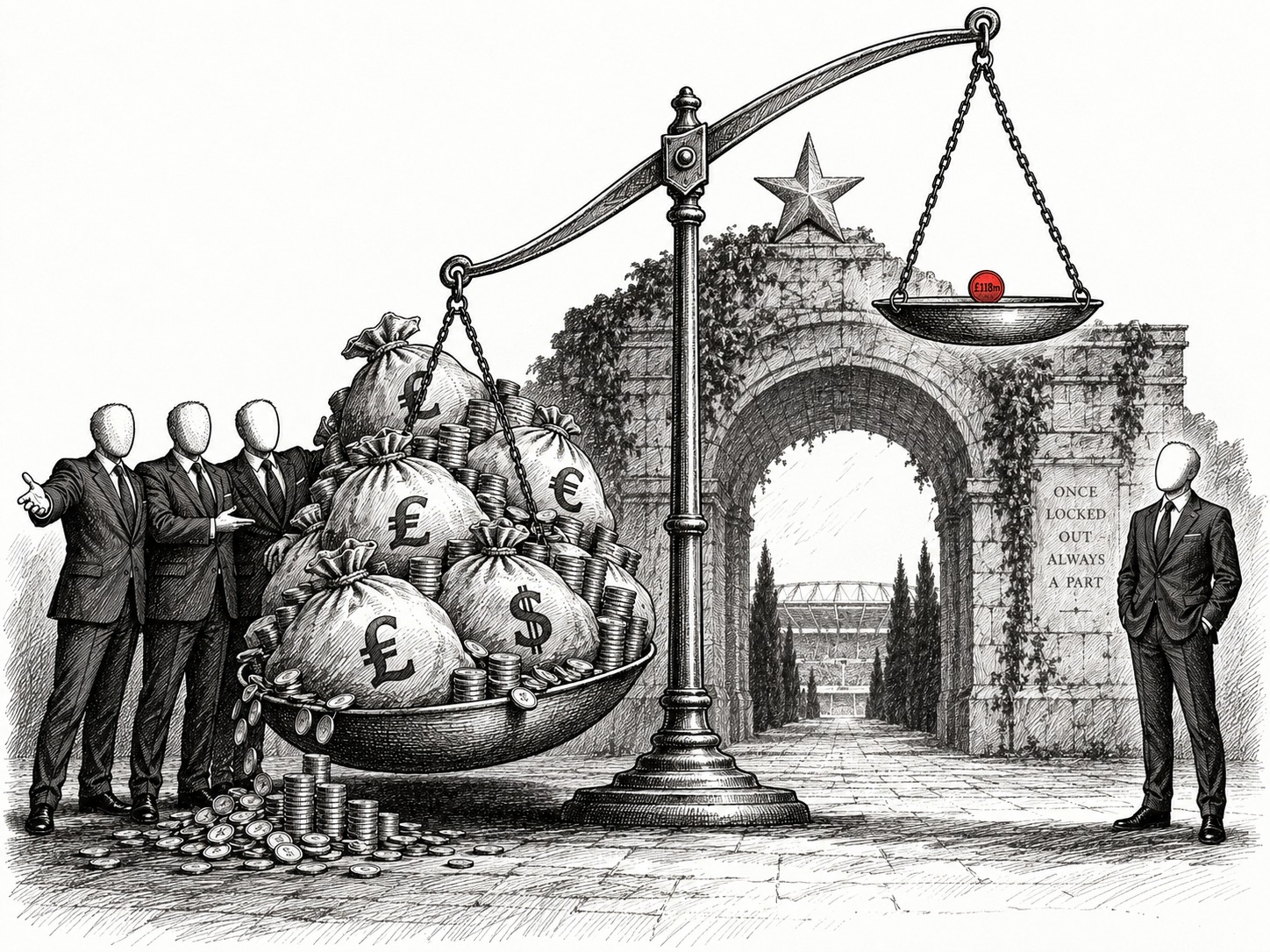
There is a specific kind of quiet that follows a transfer window when nothing goes wrong. Not triumph. Not crisis. Just the sound of a football club doing something it has not done in over a decade: closing a summer market having spent, by its own historic standards, almost nothing at all.
Manchester United's 2026 summer window produced three permanent midfield signings, a free-transfer goalkeeper, and a net spend that Sky Sports put at £118m once the market shut on 1 September, lower than newly promoted Ipswich Town and Coventry City managed in the same window.1 Gross expenditure across the Premier League this summer reached a record £3.55bn, with Manchester City alone accounting for £440.3m of it.2 United's share of that record-breaking market, by contrast, was modest enough to rank them ninth among Premier League clubs by gross outlay and lower still by net spend, depending on which dataset you trust.3
This is not, on its own, a story. Clubs have quiet windows. What makes it worth writing down is the context it arrived in: United finished third in the Premier League last season under Michael Carrick, secured a return to the Champions League after a three-year absence, and used almost none of the transfer market's record liquidity to reinforce that position.4 Every other club that spent this modestly this summer was either selling its best players for profit or building a promoted squad from the bottom of the table. United is neither. It is the only club in the Premier League that improved its European standing this summer while behaving, in the transfer market, like a club trying not to be noticed.
The company it kept
It is worth sitting with that comparison for exactly one paragraph, because it is genuinely instructive and does not need to be laboured. Ipswich Town, promoted from the Championship, posted a net spend of roughly £190m rebuilding a squad for top-flight survival.5 Coventry City, still in the Championship, spent close to £130m net trying to force their way up.6 Manchester United, twenty-time English champions, sitting in the Champions League for the first time in three years, spent less than both of them. That is not a criticism dressed as a fact. It is simply the fact, and it is the kind of fact a serious publication is obliged to let sit there rather than rush past.
Where United Sits
Net transfer spend across the Premier League, summer 2026. United clears Arsenal by a nose and sits nowhere near the clubs it's supposed to be competing with again.
The pattern this breaks
To understand why this window reads as deliberate rather than incidental, it helps to look at what Manchester United's transfer windows have looked like for most of the last decade. The house style, under the Glazers and largely unchanged through several regimes of sporting leadership, was the marquee arrival: a single, expensive, headline-generating name, usually recruited from continental Europe, usually announced with the kind of production values that suggested the signing itself was the achievement.
Jadon Sancho arrived from Borussia Dortmund for around £73m in 2021.7 Casemiro joined from Real Madrid a year later for an initial £60m rising to £70m with add-ons, a deal announced with the kind of statement usually reserved for a trophy arriving rather than a player.8 Antony followed weeks later from Ajax for a fee widely reported at £85m, a figure that would go on to become one of English football's more frequently cited cautionary numbers; Gary Neville later listed it among the club's clearest transfer mistakes.9 Each of these deals shared a structure: one high-profile individual, one continental selling club, one number designed to dominate the back pages for a news cycle.
This summer's business looked nothing like that. Andrey Santos arrived from Chelsea, Youri Tielemans from Aston Villa, and Carlos Baleba from Brighton, three Premier League-proven midfielders bought from direct domestic rivals rather than imported as continental unknowns.10 Exact fees vary meaningfully by source, a recurring problem with in-window reporting before a fee is confirmed in an annual account, but the reported range sits at roughly £35-47m for Tielemans, £48-67.5m for Santos, and £70-94.5m for Baleba depending on how add-ons are counted.10 No single figure among them approaches the old marquee threshold. No single name was sold to supporters as the moment the window was won. The closest thing to a headline was Michael Carrick telling reporters, with the flat satisfaction of a man who has learned not to oversell things, that he believed the squad had "gotten stronger" despite a "challenging" window.1
One Name vs Three
The old pattern: one continental name, one enormous fee. The new one: three Premier League incumbents, bought from the clubs United now has to beat.
| Year | Signing | Fee | Selling club |
|---|---|---|---|
| The marquee era | |||
| 2021 | Jadon Sancho | £73m | Borussia Dortmund |
| 2022 | Casemiro | £60-70m | Real Madrid |
| 2022 | Antony | £85m | Ajax |
| Three signings, three countries | ~£220m | ||
| The modesty play | |||
| 2026 | Youri Tielemans | £35-47m | Aston Villa |
| 2026 | Andrey Santos | £48-67.5m | Chelsea |
| 2026 | Carlos Baleba | £70-94.5m | Brighton |
| Three signings, one league | ~£153-210m | ||
There is a reading of this that is purely footballing: United needed Premier League-tested depth in one specific area of the pitch, found it domestically, and paid sensible prices for proven quality instead of overpaying for reputation. There is also a reading that is purely financial, and the two are not mutually exclusive.
The ledger this doesn't show yet
Manchester United's financial year runs to 30 June, which means this summer's spending will not appear in a published account until the FY2027 results, alongside the club's first season of Champions League broadcast and prize income since 2023/24.12 Nothing about this window, in other words, has yet been tested against a balance sheet. What is known, from the FY2026 figures already published, is the shape of the constraint it was negotiated inside: full-year revenue guidance of £640-660m and adjusted EBITDA guidance of £180-200m, alongside a dividend freeze now in its fourth consecutive fiscal year, running from the board's decision on 15 November 2022 not to declare the fiscal 2023 dividend through FY2026.1213 The debt structure refinanced in June 2026, documented at length elsewhere on this site, remains the fixed cost this summer's transfer business had to work around.15
That combination, a club returning to European football's most lucrative competition while still operating under a dividend freeze and a refinanced debt load, is precisely the condition under which a modest transfer window stops looking like an accident and starts looking like a policy. Whether that policy was chosen or imposed is the question this essay cannot yet answer with certainty, and a forensic publication should say so plainly rather than pretend otherwise.
The Ledger Nobody's Seen Yet
This summer's spend and this season's Champions League income won't share a page until next autumn. Every verdict written now, including this one, is provisional.
Reading it through the framework
Run this window through Glazernomics' usual instruments and it produces an unusually clean, if incomplete, picture.
Looks favourable on paper. Three Premier League-proven signings for a combined net outlay below the historic single-signing fees of the ten Hag era is, on cost-per-unit-of-certainty terms, a more disciplined transaction than the Antony or Sancho deals it implicitly replaces as the club's transfer-market personality. Buying known quantities from domestic rivals is a lower-variance bet than buying reputation from abroad, and the price reflects that.
The return actually delivered on the pitch, cannot be scored yet. The squad is being assembled for a first four-competition season in three years, and its adequacy will be judged across a campaign, not a transfer window. What can be said is that the club did not gamble a marquee fee on a single unproven fix, which at minimum limits the scale of the downside if the recruitment misjudges the level required.
The return captured by ownership, has not moved. No dividend has been paid across four consecutive fiscal years, and this window did nothing to change that. Put beside the club's own extraction history, the freeze looks smaller still: Swiss Ramble's itemised estimate puts interest, debt repayment and dividends combined at roughly £1.06bn between 2005 and 2022, against which four years of zero barely registers as a rounding error, let alone a change in philosophy.14 If restrained recruitment is, in part, a function of debt service and refinancing terms rather than footballing philosophy, it complicates any reading of this summer as pure sporting discipline. A club can look prudent and be constrained at the same time; those are not opposites, and Glazernomics has no evidence yet to separate the two explanations cleanly.
The Freeze, at Scale
Four years without a dividend looks like discipline only until it sits on the same axis as what came out before. On that axis, it flatlines.
The verdict, for now
The honest position is that this window cannot be fully scored until the FY2027 accounts exist and a season's worth of Champions League football has been played against it. What can be said now, and what makes this worth writing about before that evidence arrives, is the sheer novelty of the position United find themselves in: a club whose transfer-market instincts have historically run toward the expensive and the continental spent a record-breaking Premier League summer behaving like a club with something to prove about restraint rather than ambition.
Whether that restraint turns out to be the first sign of a more disciplined institution, or simply what a debt-serviced ownership model looks like when it can no longer afford the old kind of statement, is not a question this window answers. It is the question next summer's window, and the FY2027 accounts that will finally sit alongside it, are going to have to.
References
- Sky Sports, "Manchester United latest: Michael Carrick happy with transfer business," 6 September 2026. skysports.com
- Sky Sports, "Summer transfer spending: Premier League, EFL, WSL, Scottish Premiership, LaLiga, Ligue 1, Serie A and Bundesliga breakdowns," 4 September 2026. skysports.com
- SI.com, "Premier League Transfers: Total Money Spent by Clubs in 2026 Summer Window." si.com
- SI.com, "2026-27 Champions League Draw: Man Utd's Potential League Phase Opponents"; ManUtd.com, "UEFA Champions League qualification assured after Liverpool clash," 3 May 2026. manutd.com
- Yahoo Sports, "The Premier League clubs with the biggest net spend in summer 2026." sports.yahoo.com
- Squawka, "Premier League Net Spend 2026-27: Rankings Revealed." squawka.com
- Historical reporting on the 2021 Jadon Sancho transfer from Borussia Dortmund, widely reported fee circa £73m.
- Dhaka Tribune / AFP, "Man Utd agree to sign Real Madrid midfielder," 19 August 2022. dhakatribune.com
- Football España, citing Gary Neville's list of Manchester United transfer mistakes, December 2023. football-espana.net
- GiveMeSport, "All Completed Man Utd Transfers in 2026/27"; Heavy.com, "Manchester United 2026 Summer Transfer Window: All Signings and Departures." Fee ranges reflect base-fee vs fee-including-add-ons reporting.
- Manchester United plc Q2 FY2026 results, reported via Barchart, February 2026. barchart.com
- Malay Mail / AFP, "Man Utd owners halt dividend payments," 9 December 2022, reporting the board's 15 November 2022 decision not to approve the fiscal 2023 dividend. malaymail.com
- Footballtransfers.com, citing Swiss Ramble's estimate of Glazer-era extraction (interest £743m, debt repayments £147m, dividends £166m since 2016); The Athletic's Laurie Whitwell separately estimated cumulative Glazer proceeds near £450m using a narrower definition. footballtransfers.com
- Glazernomics, "Success, On Credit" (Mid-Year Report No. 01), glazernomics.com/reports/success-on-credit.html; Glazernomics A-Z Archive, "Refinancing Events," "Dividends," "Cash Extraction."