Definition & Scope
This entry documents the relationship between capital allocation decisions at Manchester United and the condition of Old Trafford stadium between 2005 and the present. It covers: documented instances of physical deterioration at the ground; the scale of annual capital expenditure at Old Trafford relative to other financial outflows; a quantitative comparison with stadium investment made by peer clubs in the same period; the revenue consequences of constrained capacity and outdated infrastructure; and the compounding financial costs of deferred redevelopment. This entry draws exclusively from its assembled Evidence Pack. It does not assess ownership intent, attribute fault beyond what is stated by named sources, or evaluate the merits of alternative capital decisions.
The Asset in 2005
At the time of the Glazer family's leveraged buyout in June 2005, Old Trafford was the largest club football stadium in England, having reached a capacity of approximately 74,000 through phased expansions in the 1990s and early 2000s. The final structural addition - an additional tier to the Sir Alex Ferguson Stand - was completed in 2006, returning the ground close to its original 80,000 capacity and establishing it as the dominant club venue in the United Kingdom.1 In the years immediately preceding and following the takeover, the stadium was regularly cited as a benchmark for matchday revenue and infrastructure in European football.
Physical Deterioration: A Documented Timeline
The most publicly documented symptom of underinvestment at Old Trafford is recurring failure of the stadium's roof drainage system during heavy rainfall. Incidents have been recorded in 2012, 2019, 2022, 2023, and May 2024.6 In 2019, water cascaded from the Stretford End during a home defeat by Manchester City.4 The same fault recurred at a defeat by Crystal Palace in September 2022.4 In May 2021, water reached electrical equipment in the press box of the Sir Bobby Charlton Stand, documented by a correspondent from The Times.7
The most widely reported incident occurred on 12 May 2024, following a 1–0 defeat by Arsenal, when approximately 41mm of rainfall in two hours produced visible water ingress across multiple areas of the stadium, including the away dressing room.5 The club acknowledged recurring faults with the drainage system but stated that permanent repair had been deferred, linking any roofing decision to the broader stadium strategy review - a position it had held since at least December 2021.4 Co-owner Sir Jim Ratcliffe confirmed publicly in 2024–25 that the roof leaks and that underground player arrival - standard at comparable modern venues - is absent at Old Trafford.11
Beyond the roof, secondary documented issues include a debris incident in a stadium concourse in November 2023, a food safety failure at an internal club event in the same month, and corporate hospitality facilities described across multiple independent sources as materially below those available at newer Premier League venues.8
Capital Expenditure at Old Trafford
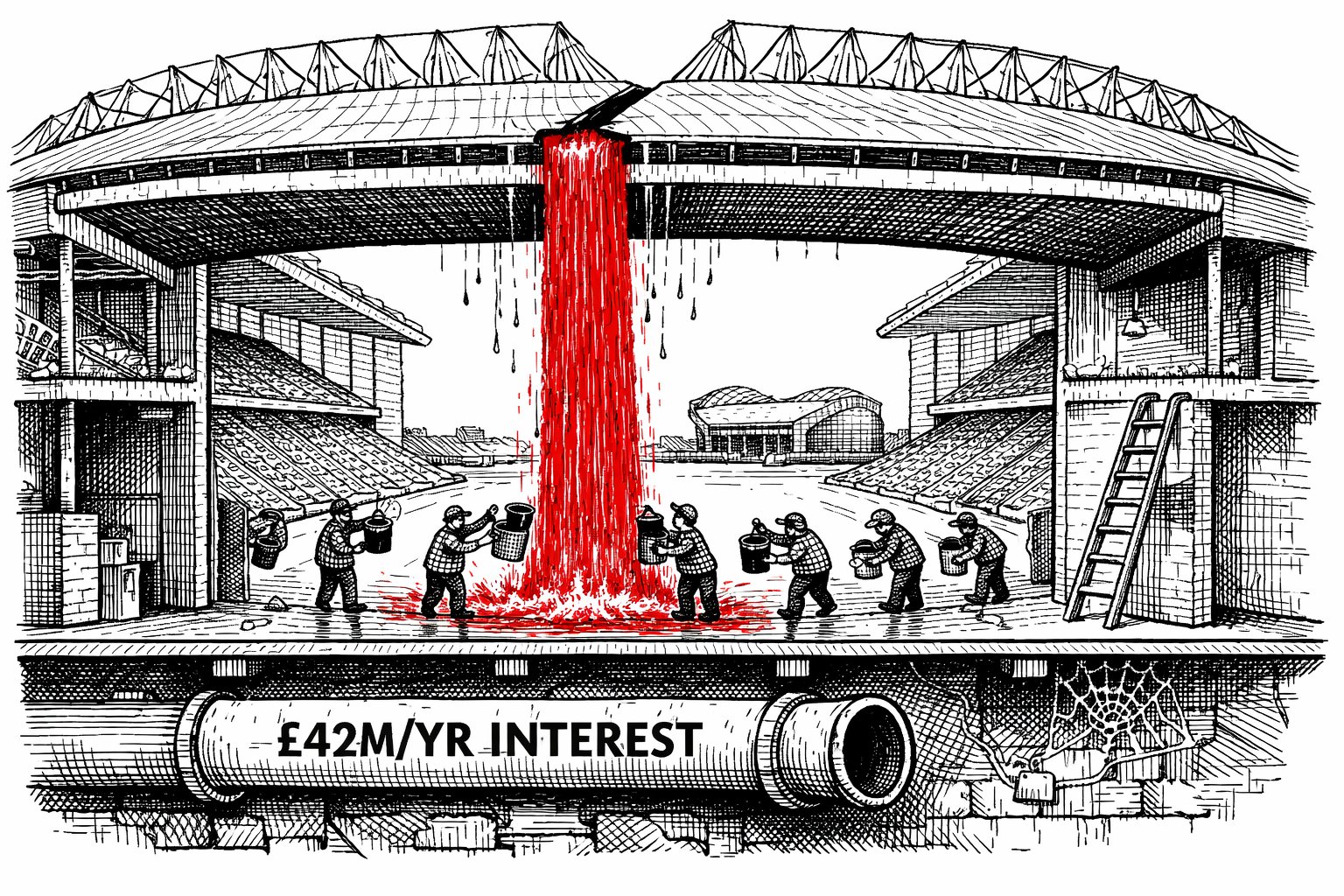
Annual capital expenditure at Old Trafford is disclosed separately in Manchester United's SEC-filed annual reports. For the three most recently reported fiscal years, the figures are: £13.4m in FY2023, £8.2m in FY2024, and £13.1m in FY2025, described in all three cases as general maintenance and upgrades.2 In the same period, average annual interest paid on the club's debt was approximately £35–37m per year.19 The average annual cash outflow on player registrations over the five fiscal years to FY2025 was £135.8m, as reported in the club's Form 20-F.20
In FY2025, total non-player capital expenditure rose to £51.9m - described as the highest recorded under Glazer family ownership.3 However, £42.0m of that figure was attributable to the new Carrington training facility. Old Trafford's share was £9.9m, consistent with prior years.3 The club's USD non-current borrowings remained unchanged at $650m as of 30 June 2025.20
The Peer Investment Gap
Three peer clubs made material stadium investments during the period in which Old Trafford received only maintenance-level expenditure. The revenue consequences of each are documented.
Arsenal opened the Emirates Stadium in 2006 at a cost of approximately £390m.18 The 60,000-capacity venue replaced the 38,000-seat Highbury and immediately expanded the club's matchday revenue capacity.
Tottenham Hotspur opened the Tottenham Hotspur Stadium in April 2019 at a final cost of approximately £1.2bn, confirmed by club chairman Daniel Levy.14 The club's matchday revenue grew from £45.3m in their final season at White Hart Lane (2016–17) to £117.6m in 2022–23 - a 159% increase.15 In 2023–24, Tottenham's matchday income was £106m, with catering alone generating an estimated £800,000 per home match.15
Real Madrid invested €1.347bn in a full renovation of the Santiago Bernabéu stadium between 2019 and 2024, financed through three loans totalling €1.17bn at an average rate of 3%.16 The club's matchday revenue approximately doubled to €248m in 2023–24 following renovation, as documented in the Deloitte Football Money League.17 Real Madrid's total revenue reached €1.185bn in 2024–25 - the second consecutive year above €1bn - with the renovated stadium identified by Deloitte as a primary driver.16,17
Against this backdrop, Manchester United's matchday revenue grew from £98.7m in 2011–12 to £137m in 2023–24, a period in which the ground received no structural investment.10,11 In 2023–24, Manchester United's Deloitte matchday revenue of €152.1m ranked fourth among the top 20 Money League clubs - behind Real Madrid (€248m), Paris Saint-Germain (€171.1m), and Arsenal (€153.4m) - despite Old Trafford being larger in capacity than any of those three venues.12 Manchester United's overall Money League ranking fell to 8th in 2024–25, the club's lowest position in the publication's history.13
Revenue Consequences
Manchester United has averaged over 99% of capacity for Premier League matches in each of the last 21 seasons - a figure the club reports in its own investor documentation.9 At full occupancy, matchday revenue is a function of seat count, ticket pricing, and hospitality yield, not demand. Revenue growth at Old Trafford is therefore structurally constrained by the fixed capacity and the quality of the built environment rather than by audience interest.
The Real Madrid benchmark quantifies what stadium investment can generate. Prior to the Bernabéu renovation, Real Madrid's matchday revenue was approximately €140m per year. Following completion, it reached €248m in 2023–24 - an incremental uplift of over €100m annually from a capital programme of €1.347bn.16,17 No comparable investment has been made at Old Trafford in the same period.
Old Trafford's exclusion from the UEFA Euro 2028 host stadium list, confirmed in April 2023, represents a further documented consequence. The club withdrew having been unable to guarantee the ground's availability for the tournament;28 the Etihad Stadium was selected as Manchester's Euro 2028 host venue. The revenue and reputational value of hosting a major international tournament at a club's home ground is not quantified in available sources but represents a documented lost opportunity.
Financial Constraints and Capital Allocation
The Glazer leveraged buyout in June 2005 placed £604m of gross debt on Manchester United's balance sheet; the club had been debt-free since 1931.19 Average annual interest costs since 2005 have been approximately £42m, with £37.2m paid in FY2024.19 Between 2010 and 2022, Manchester United paid £517m in interest - characterised in Swiss Ramble analysis, cited by Goal.com, as roughly equivalent to the cumulative interest payments of the rest of the Premier League in the same period.22
Dividend payments to shareholders, the majority of which accrued to the Glazer family, averaged approximately £22m per year from 2016 to 2024 and exceeded £150m in total.21 Manchester United was the only Premier League club to pay regular dividends to shareholders during this period.21
Between 2012 and 2021, Manchester United received net negative funding from its owners of minus £154m, meaning the club remitted more to its owners than it received.22 In the same period, Manchester City's owners invested £684m in the club and Chelsea's owners invested £516m.22 Against these outflows, annual Old Trafford capital expenditure did not exceed £15m in any fiscal year for which data is available. Average annual player registration expenditure over the five years to FY2025 was £135.8m - approximately ten to sixteen times the annual Old Trafford maintenance budget.2,20
INEOS's acquisition of a 27.7% stake in February 2024 was accompanied by a commitment to invest $300m (approximately £236m) in infrastructure.20 The first evidence of this investment was the new Carrington training facility, which opened in August 2025 at a total cost of approximately £55m.3
Euro 2028 Exclusion
Old Trafford was included in the original 14-stadium shortlist for the UK and Ireland's UEFA Euro 2028 bid, submitted in November 2022. In April 2023, Manchester United withdrew the stadium from consideration.28 The formal reason was an inability to guarantee the ground's availability for the 2028 tournament - a consequence of unresolved uncertainty over the stadium's redevelopment timeline.28 The Etihad Stadium was confirmed as Manchester's Euro 2028 host venue.
Gary Neville, former Manchester United captain, described in 2023 how Old Trafford had "gone from being one of the best stadiums in the world to one that can't even get into the top 10 in the UK and Ireland."27
The Cost of Delay
A stadium strategy review, completed in 2024, concluded that refurbishment of Old Trafford would cost between £1bn and £1.2bn and would require a reduction in stadium capacity during the construction period.23 On this basis, the club's recommendation was a new-build option. In March 2025, plans for a 100,000-seat stadium designed by Foster + Partners were announced at an estimated cost of approximately £2bn.24 Industry analysis published in March 2026 indicated that, with current construction inflation and potential delays, the final cost could exceed £3bn if the full design is retained.25 As of that date, no construction had commenced; financing had not been confirmed.25
The deferred redevelopment rationale was first articulated publicly in 2018 by the then-Managing Director Richard Arnold, who stated that a major Old Trafford redevelopment would be "a multi-season challenge" and that it was "not certain that there's a way of doing it which doesn't render us homeless."26 That statement was made seventeen years into the Glazer ownership period, and at least a decade after Arsenal, and then Tottenham, had completed comparable projects at their own grounds.
What This Entry Does Not Claim
This entry does not attribute the condition of Old Trafford to deliberate policy or negligence on the part of any named individual. It does not conclude that the observed capital allocation pattern was suboptimal, nor does it predict the outcomes of the current stadium project. The documented pattern - low infrastructure investment, sustained high debt service, peer clubs making large stadium investments in the same period, and a matchday revenue trajectory constrained by fixed capacity - is presented as factual record. All evaluative commentary cited in this entry is attributed to named external sources and presented as their assessment, not as editorial position.
References
- 1.Wikipedia (2024). Old Trafford. en.wikipedia.org/wiki/Old_Trafford
- 2.Manchester United plc / MarketScreener (2025). Annual Report FY2025 (Form 20-F). marketscreener.com
- 3.Greg Cordell / Substack (2025). Manchester United FC: 2024/25 Financial Results. gregcordell.substack.com
- 4.Irish Times (2024). Manchester United failed to fix Old Trafford roof despite knowledge of leaks. irishtimes.com
- 5.Yahoo Sports / Sky Sports (2024). Old Trafford Arsenal dressing room flooding footage. sports.yahoo.com
- 6.Wikipedia (2024). New Trafford Stadium. en.wikipedia.org/wiki/New_Trafford_Stadium
- 7.UnitedInFocus (2021). Manchester United respond to 'leaking roof' criticism and explain Old Trafford plans. unitedinfocus.com
- 8.GiveMeSport (2024). Explaining the 5 biggest issues that Man Utd need to address with Old Trafford urgently. givemesport.com
- 9.Manchester United plc (IR) (2019). Business Model - Manchester United. ir.manutd.com
- 10.Manchester United plc (IR) (2019). Business Model - matchday revenue FY2017–19. ir.manutd.com
- 11.Fox Sports (2025). Man Utd take next step towards Old Trafford redevelopment. foxsports.com
- 12.The Stadium Business / Deloitte (2025). Matchday revenue sees Real Madrid retain Money League top spot. thestadiumbusiness.com
- 13.Deloitte (2026). Deloitte Football Money League 2026. deloitte.com
- 14.Wikipedia (2024). Tottenham Hotspur Stadium. en.wikipedia.org/wiki/Tottenham_Hotspur_Stadium
- 15.VAVEL International (2024). Tottenham Hotspur Stadium: The Financial Juggernaut Powering Levy's Tottenham. vavel.com
- 16.Real Madrid (2025). Real Madrid closes the 2024/25 financial year - official financial report. realmadrid.com
- 17.The Stadium Business / Deloitte Money League 2025 (2025). Matchday revenue sees Real Madrid retain Money League top spot. thestadiumbusiness.com
- 18.DailyCannon (2023). How did Arsenal and Tottenham pay for their stadiums? dailycannon.com
- 19.BBC Sport (2025). How the Glazer family cost Manchester United £1.2bn. bbc.com
- 20.Manchester United plc / Business Wire (2025). Manchester United PLC Reports Fourth Quarter and Full Year Fiscal 2025 Results. businesswire.com
- 21.Yahoo Finance / 90min (2022). Manchester United and the Glazers' debt explained. yahoo.com
- 22.Goal.com (citing Swiss Ramble) (2023). Glazers must take blame for exhausted Man Utd's miserable end to the season. goal.com
- 23.Architects' Journal / Foster + Partners (2025). Foster + Partners reveals plans for Man Utd's new 100,000-seat stadium. architectsjournal.co.uk
- 24.Irish Times (2025). Manchester United to build new 100,000-capacity stadium next to Old Trafford. irishtimes.com
- 25.StadiumDB (2026). Manchester United problems: new stadium getting more expensive, timeline extending. stadiumdb.com
- 26.GiveMeSport (2024). Why Manchester United's famous Old Trafford stadium is falling apart. givemesport.com
- 27.Planet Football (2023). 9 amazing UK stadiums NOT selected to host Euro 2028 matches. planetfootball.com
- 28.GiveMeSport / UEFA Euro 2028 (2023–25). Euro 2028: Why Anfield and Old Trafford will not host any games. givemesport.com