Overview
A leveraged buyout (LBO) is an acquisition in which the purchase price is funded primarily through debt, with that debt subsequently placed on the balance sheet of the acquired company rather than the acquirer. The assets and future cash flows of the target company serve as collateral for the loans. The effect is that the acquired entity — not the buyer — bears the financial obligation of its own acquisition.
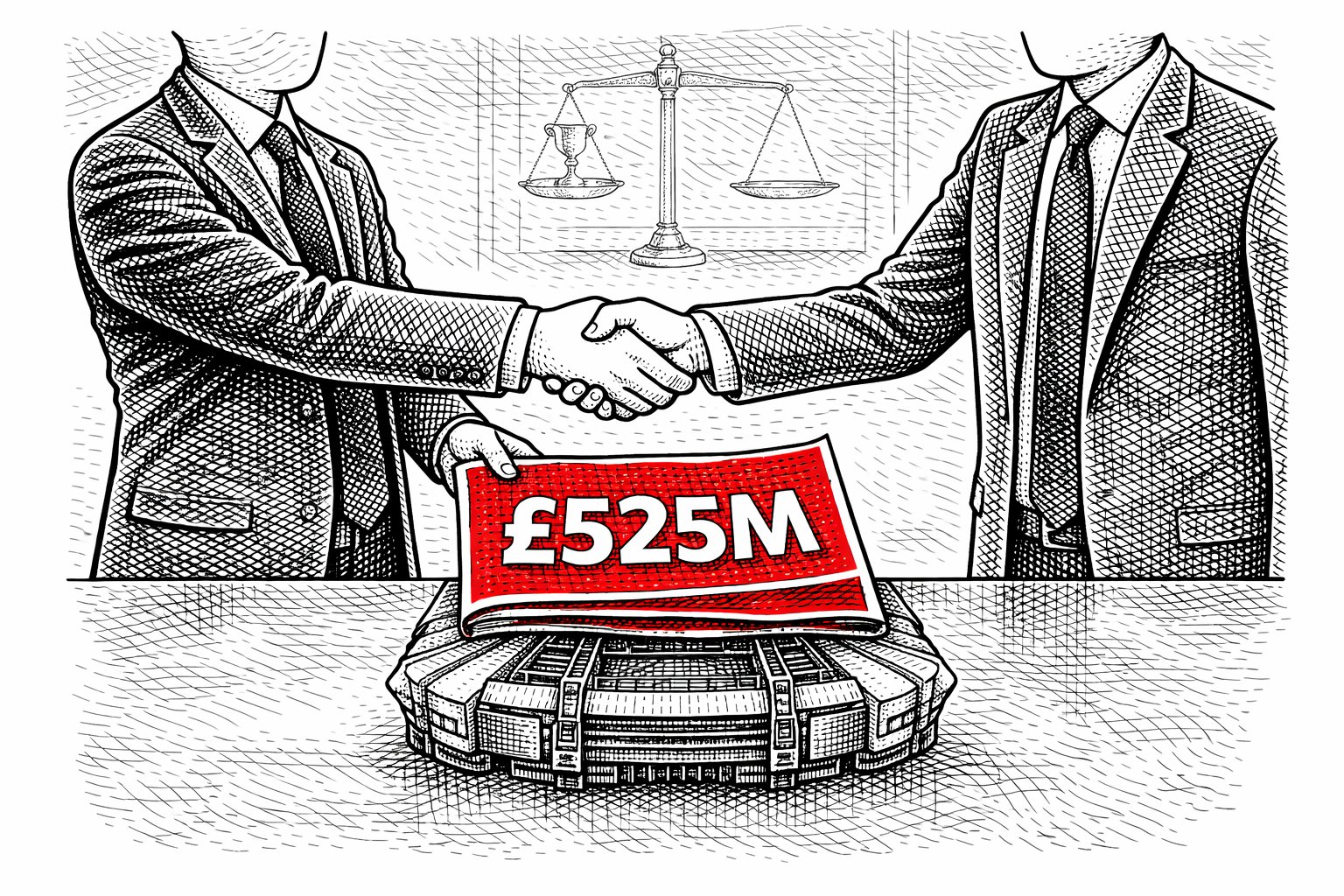
The Glazer family's acquisition of Manchester United in May 2005 is the defining example of this structure applied to a football club. The acquisition cost approximately £790 million.1 Of that sum, approximately £525 million was placed on Manchester United's own balance sheet as acquisition debt.4 The club — debt-free since 19311 and carrying only minor overdraft facilities at the time of the takeover4 — immediately became responsible for servicing financing it had not taken on for its own operational purposes.
The structure has been identified in peer-reviewed academic literature as a landmark example of LBO mechanics applied to professional sport.10 Its consequences — for debt levels, interest costs, infrastructure investment, and every major financial decision made at the club since 2005 — are documented across the Glazernomics A–Z archive. This entry records the mechanics, timeline, and immediate consequences of the acquisition itself.
Manchester United Before the Takeover
In the 2004/05 season — the last before the Glazers arrived — Manchester United was in demonstrably strong financial health. Swiss Ramble's twenty-year retrospective identifies it as the club with the highest revenue, highest EBITDA, and highest operating profit in England.2 It was also the last season in which the club reported net interest receivable rather than net interest payable — a condition that would not recur.2
The club had been debt-free in any meaningful sense since 1931.1 Pre-takeover debt comprised only minor overdraft facilities, with total interest costs across the five years before the takeover amounting to approximately £1.6 million.4 Total debt on the balance sheet was approximately £50–60 million, almost entirely short-term working capital facilities.17
The club had been a publicly listed company on the London Stock Exchange since 1991.1 A takeover bid by BSkyB in 1998 — worth £623 million — had been blocked by the government's Monopolies and Mergers Commission on conflict of interest grounds.5 The club entered 2003 as an institutionally stable, financially solvent, publicly listed business.
Stake Accumulation: 2003–2005
Malcolm Glazer began accumulating shares in Manchester United in March 2003, purchasing an initial 2.9% stake for approximately £9 million through his holding company Red Football Ltd.5 By late 2003 the family's stake had reached approximately 15%.1
The catalyst for the eventual acquisition was a dispute between Sir Alex Ferguson and two of the club's largest shareholders. John Magnier and J.P. McManus, who collectively owned 28.7% of the club through the vehicle Cubic Expression, had co-invested with Ferguson in the racehorse Rock of Gibraltar. A disagreement over stud rights created sufficient deterioration in their relationship with the club to make their stake available.5,6
On 12 February 2004, with their stake at 16.31%, the Glazers instructed Commerzbank to explore a formal takeover bid. The Financial Times reported this the following day; the club's share price rose 5%, valuing it at approximately £741 million.1 By October 2004 the Glazers were approaching the 30% threshold under the UK City Code on Takeovers and Mergers at which a mandatory offer for all remaining shares becomes compulsory.1
On 12 May 2005, Red Football acquired the Cubic Expression stake — 28.7% of the club — for approximately £227 million, taking the family's ownership to just under 57%.1 This triggered the mandatory offer. Within four days, the Glazers reached 75% ownership, enabling the club to be delisted from the London Stock Exchange.1 By June 2005, Red Football Ltd had reached 98% through a compulsory purchase of the remaining shares.1 The total acquisition cost was approximately £790 million.12
The LBO Structure: How It Was Financed
The acquisition was financed through a combination of debt and equity. Approximately £250 million was contributed as equity by the Glazer family.7 The remaining approximately £540 million was borrowed. That debt was structured in two tranches and distributed between the club and the Glazer holding company.
The first tranche — approximately £265 million — comprised senior bank debt arranged by JPMorgan Chase, secured against the assets of Manchester United at club level.8 This debt sat directly on Manchester United's balance sheet. The second tranche — approximately £275 million — comprised payment-in-kind (PIK) loans provided by three New York hedge funds: Citadel, Och-Ziff Capital Management, and Perry Capital.7 These PIK loans were held at the parent company level but structured with covenants enabling cash to be extracted from the club to service them.1
Together, the debt placed on or secured against Manchester United's balance sheet amounted to approximately £525 million. This figure — £525 million — is the canonical measure of acquisition debt loaded on the club in 2005. It is the figure against which twenty years of subsequent financial decisions must be understood.4
The Glazer equity contribution of approximately £250 million has been the subject of journalistic scrutiny. Credible analysis has suggested this equity may itself have been borrowed against the family's US commercial real estate portfolio rather than representing unencumbered family capital.12 This claim has not been confirmed in public filings and is treated here as attributed analysis rather than established fact.
The PIK Loan Mechanism
Payment-in-kind loans are a specific debt instrument in which interest is not paid in cash but instead added to the outstanding principal. The effect is exponential growth of the principal balance over time: each period's unpaid interest becomes part of the debt on which subsequent interest accrues. Wikipedia's entry on PIK loans specifically cites the Manchester United takeover as a prominent case study.1
The PIK loans issued in connection with the 2005 takeover carried an initial interest rate of 14.25%.9 The terms included a step-up clause: if the loans were not refinanced by August 2010, the rate would rise to 16.25%.9 By January 2010, the combined club and parent debt had reached £716.5 million9 — an increase of approximately £176 million above the original £540 million of debt, driven substantially by the compounding PIK mechanism.
In January 2010, Manchester United issued £500 million in senior secured bonds — a structural refinancing that enabled full repayment of the PIK loans by November 2010.1 The bond issue and its consequences are documented in the Refinancing Events entry.
Holding Company Structure
The acquisition was executed through a layered holding structure. Red Football Ltd — the Glazer family's UK vehicle — was the acquiring entity. Manchester United Football Club Limited, the principal operating subsidiary holding the stadium, player registrations, and commercial rights, became the debt-bearing entity within this structure.11
The club was taken private on delisting from the London Stock Exchange in June 2005, ending fourteen years as a publicly listed company.1 The Glazer family appointed six family members to the Manchester United board between 2005 and 2006: sons Avram, Joel, Bryan, Kevin and Edward, and daughter Darcie.5 The club would not return to public markets until the New York Stock Exchange IPO in August 2012. That IPO is documented in the Share Price (MANU) entry.
The bond prospectus issued in connection with the 2010 refinancing contained covenants allowing the Glazers to extract cash from the club to repay the PIK loans, and a clause entitling the family to annual dividends of up to £20 million.7 Those dividend payments are documented in the Dividends entry.
The Carrington training ground was sold and leased back to the club as part of the restructuring associated with the takeover.1 This transaction — along with the reported carving out of £95 million in cash — is documented as evidence of the mechanisms by which the LBO structure was operationalised at asset level.1
Immediate Financial Consequences
The transition from a debt-free club to a club carrying £525 million of acquisition debt was immediate and measurable. In the financial year ending June 2006 — the first full year under Glazer ownership — Manchester United had already paid £53.2 million in interest and fees.17 By the same date, total debt on the balance sheet had reached £309 million, having quadrupled from the pre-takeover level within twelve months.3
Annual debt service obligations exceeded £60 million from 2005 onwards.7 This represented a structural first charge on the club's revenue — funds that were no longer available for squad investment, infrastructure, or operational reinvestment.
Fan and Institutional Response
The fan response to the takeover was immediate and organised. On 30 June 2005, the Glazers made their first visit to Old Trafford since completing the acquisition and were required to leave in police vans due to the scale of supporter protests around the ground.14
FC United of Manchester, a breakaway club founded in direct opposition to the takeover, was legally incorporated on 14 June 2005 — within weeks of the acquisition completing.13 The 'Love United Hate Glazer' campaign and the subsequent 'Green and Gold' movement — in which supporters wore the colours of Newton Heath, the club's original precursor — became visible and sustained expressions of dissent throughout the first decade of Glazer ownership.14
The Manchester United Supporters' Trust stated explicitly at the time of the takeover that supporters would effectively be paying for someone to borrow money to own their club.9 In 2010, a wealthy supporter-led group known as the Red Knights — advised by Nomura Securities — attempted to organise a counter-bid for the club. The Glazers declined to engage. In late 2009, an offer reported to be worth £1.5 billion from a Middle East-based buyer was also reportedly rejected.15
Twenty-Year Context
The 2005 LBO placed a debt obligation on Manchester United that has never been fully extinguished. By September 2025 — twenty years after the acquisition — net debt stood at £749 million ($1.002 billion), exceeding $1 billion for the first time in the club's history.16 This figure is higher in absolute terms than the £525 million of acquisition debt loaded in 2005, despite the intervening twenty years of debt servicing, refinancing, and partial principal repayment.
The club's valuation has appreciated substantially over the same period — from approximately £790 million at acquisition to an implied valuation of approximately £4.3 billion at the time of the INEOS transaction in February 2024.9 The Glazer family has extracted value through dividends, management fees, share sales at the time of the IPO, and the partial disposal to INEOS. These mechanisms are documented in the Cash Extraction entry.
The 2005 leveraged buyout established the financial architecture within which every subsequent decision at Manchester United has been made. Its consequences for interest costs, capital expenditure, infrastructure investment, transfer spending, and the club's competitive position are individually documented across the Glazernomics A–Z archive.
Summary
The May 2005 leveraged buyout of Manchester United by the Glazer family transferred approximately £525 million of acquisition debt onto the club's balance sheet. The club had been debt-free in any meaningful sense since 1931 and was, at the time of the takeover, the highest-revenue club in England with net interest receivable. Within twelve months, annual interest and fee obligations exceeded £53 million.
The financing structure — senior bank debt arranged by JPMorgan Chase and PIK loans provided by three New York hedge funds, at initial rates of 14.25% rising to 16.25% — placed the cost of the acquisition on the acquired institution rather than on the acquiring family. The assets of Manchester United, including Old Trafford and the Carrington training ground, served as collateral for the debt.
Twenty years later, net debt stands above its 2005 level in absolute terms. The structural consequences of the LBO — for debt servicing, infrastructure, squad investment, and governance — are the subject of the Glazernomics A–Z archive.
References
- 1.Wikipedia (2024). Glazer ownership of Manchester United. en.wikipedia.org
- 2.Swiss Ramble (2025). 20 Years of the Glazers at Manchester United. swissramble.substack.com
- 3.Holistic Football / Substack (2021). The Glazers' ownership of Manchester United: distilling facts from fiction. holisticfootball.substack.com
- 4.Scribd / HBS (2016). Manchester United: The Glazer Takeover — six-year financial summary. scribd.com
- 5.Goal.com (2023). Man Utd's great decline: A timeline of the Glazer family's disastrous Old Trafford tenure. goal.com
- 6.UTD District (2023). A deep dive into the Glazer ownership of Manchester United: The full story from 2005 to now. utddistrict.co.uk
- 7.LinkedIn / Merchant (2020). The Glazers LBO buy-out of Manchester United. linkedin.com
- 8.The ESK (2025). The Analysis Series: The role of US banks in financing Premier League clubs. theesk.org
- 9.Mill Wood Finance (2024). How did the Glazers buy Manchester United? millwoodfinance.com
- 10.SSRN / Adediran & Ishola (2025). How to Buy a Football Club With No Money; Manchester United as a Case Study of the Leveraged Buyout. ssrn.com
- 11.The ESK (2026). The Analysis Series: The Glazer business empire. theesk.org
- 12.The National News (2023). Glazers' codenamed takeover unlocked Manchester United rivers of gold. thenationalnews.com
- 13.ESPN (2025). Man United fans' breakaway club, FC United of Manchester, still protesting after 20 years. espn.com
- 14.United In Focus (2022). A timeline of Manchester United fan protests against the Glazers. unitedinfocus.com
- 15.ESPN (2022). Why Manchester United supporters hate the Glazers, the club's American owners. espn.com
- 16.ESPN (2025). Man United net debt breaks $1bn after active summer window. espn.com
- 17.Footkix (2025). The Glazer Legacy: 20 Years of Debt at Manchester United. footkix.com