The Spirit
and the Letter
In April 2023, Manchester United voted to remove gambling brands from the front of matchday shirts. In May 2026, they agreed terms with Betway. Both decisions are rational. Together, they raise a question worth asking.
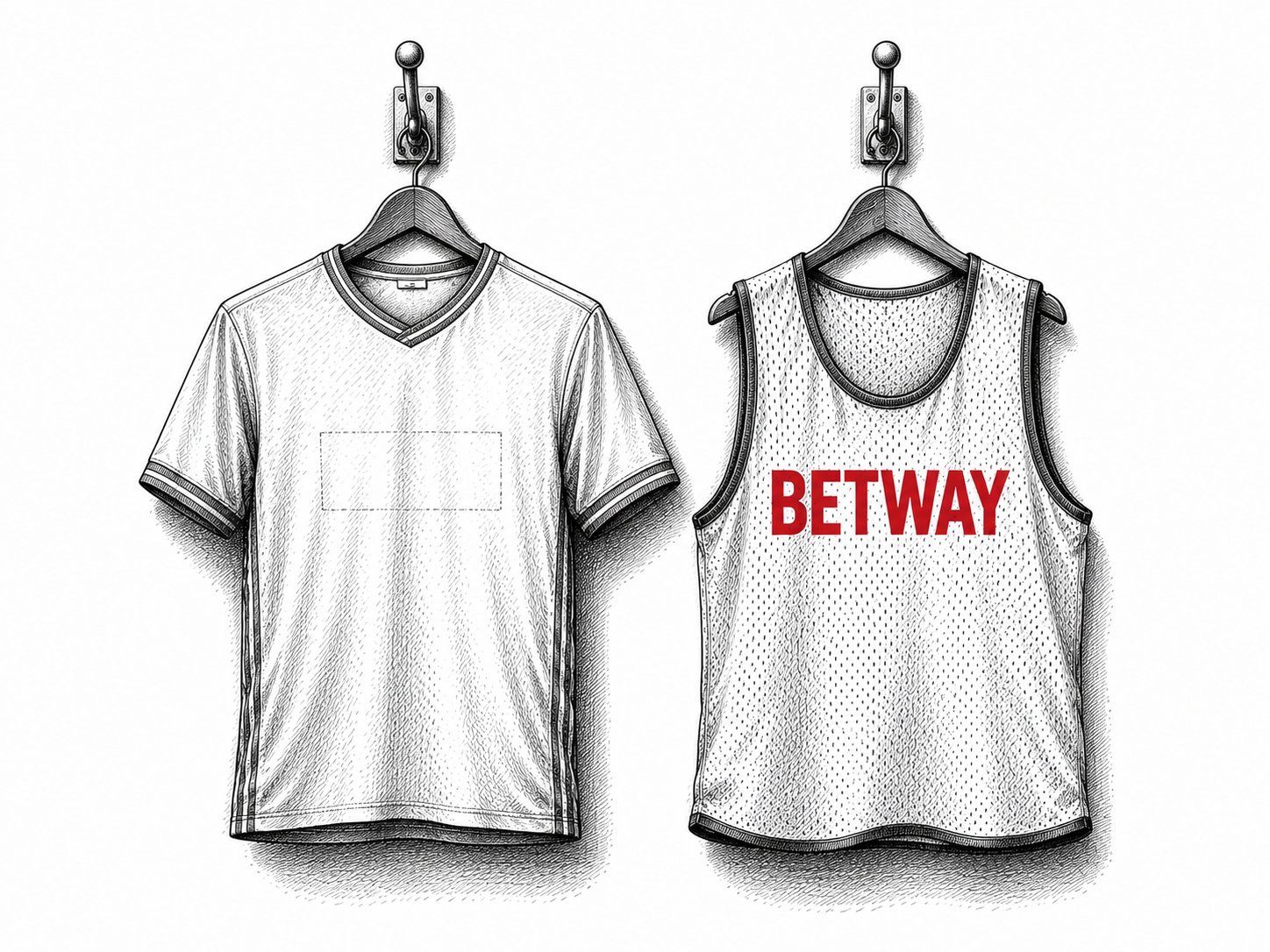
April 2023. Premier League clubs gather to vote on a voluntary measure: the removal of gambling brands from the front of matchday shirts, effective from the start of the 2026/27 season. Eighteen of twenty clubs vote in favour.1 Manchester United's individual position is not publicly recorded, but there is no indication they dissented from what was a near-unanimous decision. The vote passes. The stated purpose is clear: to reduce the visibility of gambling advertising in English football.
Three years later, in May 2026, The Athletic reports that Manchester United are in advanced talks with Betway -- a British online gambling company -- for a multi-year training kit deal worth in excess of £18 million per year.2 If confirmed, it will be the most valuable single-partner training kit deal in world football. The Betway logo will appear on training wear at Carrington, in all official club media, and in broadcast coverage of pre-match warm-ups. The same warm-ups conducted at the same stadiums the ban was designed to clean up.
Both decisions, taken in isolation, are defensible. The vote reflected a genuine shift in public and political pressure on the gambling industry's relationship with sport. The Betway deal reflects a commercial reality: training kits fall outside the regulatory perimeter the vote drew, and the market for that inventory has expanded precisely because gambling operators need somewhere to go. United are not breaking any rule. They are, in the precise sense, within the letter of what was agreed.
What the Ban Actually Covers
The April 2023 vote restricted gambling brand placement on one surface: the front of matchday shirts.1 It did not restrict shirt sleeves. It did not restrict training kits. It did not restrict perimeter advertising, stadium signage, or digital channels. Eleven clubs carried front-of-shirt gambling sponsors in 2025/26, the final season before the restriction took effect.3 From 2026/27, those deals must move or end.
This is not a narrow loophole. It is a large and well-lit door. Training kit branding appears in official club media, pre-match warm-ups in full stadium view, player interviews, and social content. The exposure it provides is not meaningfully different in kind from shirt-front placement -- it reaches the same audiences, through the same channels, with comparable visual prominence. The gambling operators displaced from shirt fronts understood this immediately. Unable to hold the most valuable inventory, they pivoted to the next most valuable. The secondary market was a predictable consequence of a ban drawn too narrowly to achieve its stated purpose.
"Training kit branding provides sponsor exposure in the same media channels, to the same audiences, with comparable visual prominence to the shirt-front placement the ban restricts."
Glazernomics — Training Shirt Sponsorship, A–Z ArchiveThe Betway Context
Betway is not an unfamiliar name in English football. Between 2015 and 2025, it served as principal shirt sponsor for West Ham United, with deal value rising from approximately £6 million to £10 million annually across that period.4 It has held commercial relationships with Manchester City, Arsenal, and Brighton. In 2021, Betway was issued a £11.6 million fine by the UK Gambling Commission for social responsibility and anti-money-laundering failures -- one of the largest such fines recorded at the time.5
At the United deal's reported floor of £18 million per year, Betway would be paying roughly 80% more annually than it paid West Ham at peak. The premium reflects both the scale of United's media reach and the supply-side dynamics created by the ban: with multiple clubs simultaneously seeking training kit replacements for lost shirt-front gambling revenue, the market has become competitive -- for buyers.2 Scarcity and desperation among sellers are features, not bugs, of a regulatory displacement. United, with the most valuable training kit inventory in England, are among the chief beneficiaries of the restriction they voted to impose on others.
The Question Worth Asking
This editorial does not argue that the Betway deal should be blocked, that United have acted in bad faith, or that gambling sponsorship in sport is straightforwardly wrong. Those are broader questions, properly contested, and not ones this publication is positioned to answer on behalf of anyone.
The question it does ask is narrower and more precise: did United -- and the other seventeen clubs that voted with them -- vote to reduce gambling advertising in football, or did they vote to remove gambling advertising from a specific surface they were willing to give up?
The two are not the same thing. A club that votes to ban gambling from shirt fronts while simultaneously positioning its training kit as a premium gambling advertising vehicle has not reduced gambling's presence in its commercial ecosystem. It has restructured it. The total gambling exposure -- Betway on the training kit, Betfred as official UK betting partner, Parimatch as official betting partner across Asia and the Middle East6 -- has not shrunk. It has, if anything, expanded. The banner has changed. The business has not.
None of this is illegal. None of it is irrational. From a pure commercial standpoint, United have executed a sensible piece of inventory management: converting a restricted channel into a premium in an adjacent one. The archive records it without judgement. The editorial merely notes that the spirit of a vote and the logic of a commercial strategy can point in different directions simultaneously -- and that when they do, it is worth saying so clearly.
The vote was for the letter. What it was for beyond that is a question Manchester United's commercial team has already answered -- quietly, and in writing.
Notes